Available Nationwide • Onsite & Virtual • Fast Turnaround
Trusted by Fortune 500 Companies Nationwide LIVE EVERY WEEK · NOT A RECORDING

The Weekly 2027 NFPA 70E Class
Led by Industry Veterans. Not a Classroom Exercise.

One standing class, every week — the 8-Hour Qualified Electrical Worker course, taught live by one of our Certified Safety Professionals (CSP), each with 35+ years of industry experience, built on the 2027 NFPA 70E edition. Need something more tailored? We also deliver onsite, virtual, and custom scenario-based training priced to scale across your whole team.

Request a Quote Onsite Training Virtual Training
Upcoming Classes — Open Enrollment
Class
Date
Time
Seats
Status
Enroll
Have 15+ people? Book a private day →
CSP-Certified Instructors
Certified Safety Professionals (CSP)
2027 NFPA 70E Current
Up-to-date with the latest standard
Hundreds of Sessions
Fortune 500 & industrial clients
OSHA-Aligned Content
1910.332/333
1926 Subpart K
Onsite & Virtual
Four Formats — nationwide

Among the teams we’ve trained

The 2027 NFPA 70E Standard Changed.
Is Your Program Still Compliant?

The 2027 edition took effect May 6, 2026 — with a mandatory second-person requirement for energized work, new verification testing rules, contact thermal hazard PPE, and battery & solar provisions. Get every change explained, plus a 90-day implementation roadmap and gap-assessment checklist.

Our training doesn't just satisfy a compliance checkbox — it changes behavior, reduces incidents, and builds a culture of electrical safety that lasts.

9.6/10
Trainee satisfaction score
Based on post-class surveys
82%
Would recommend us
Vs. ~40% industry average
62%
Score a perfect 100%
On the final knowledge check
30+
Years field experience per instructor
CSP-certified, OSHA Authorized instructors

Arc Flash Safety Training That Sticks

Every program — onsite NFPA 70E training at your facility, live virtual NFPA 70E training every week, and arc flash safety training tracks from awareness to QEW — is custom-built for your industry, led live by a CSP-certified instructor, and designed to drive real behavioral change, not just pass a test.

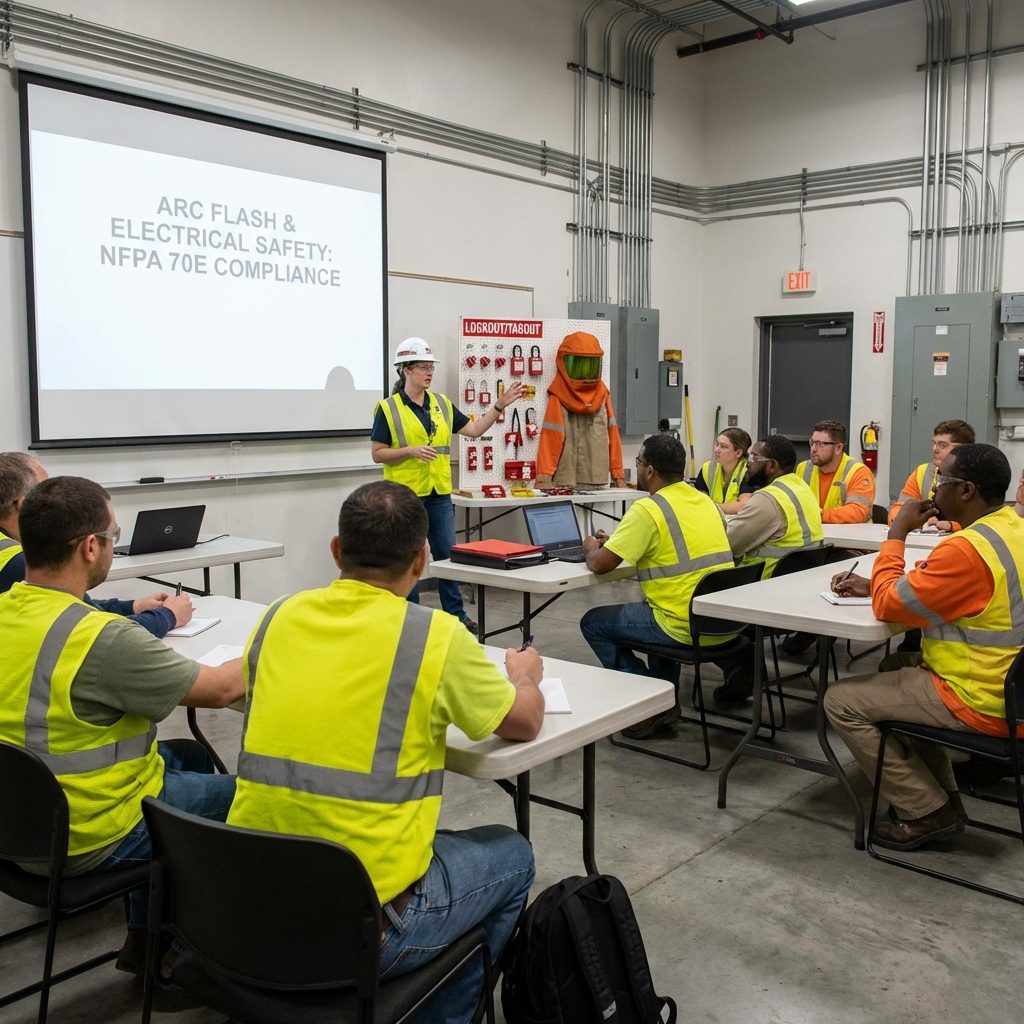
Onsite 2027 NFPA 70E training at industrial facility
Onsite Training
We Come to You

We travel to your facility and deliver live, hands-on 2027 NFPA 70E training built around your equipment, processes, and workforce — never a one-size-fits-all script. Groups capped at 20.

  • Four formats: 4-Hour to 2-Day Intensive
  • Awareness, Refresher, QEW & Intensive QEW tracks
  • Arc flash risk assessment & PPE selection
  • Lockout/Tagout (LOTO) procedures included
  • Arc flash certification provided
Learn more →
Virtual 2027 NFPA 70E safety training session
Virtual Training
Live. Interactive. Anywhere.

Our virtual sessions deliver the same expert instruction as onsite — live, interactive, and never pre-recorded. Groups capped at 20 to ensure real engagement with the instructor.

  • Four formats: 4-Hour to 2-Day Intensive
  • Awareness, Refresher, QEW & Intensive QEW tracks
  • Full 2027 NFPA 70E curriculum — live instructor
  • Delivered via Zoom or Microsoft Teams
  • Arc flash certification & completion records
Learn more →
Custom group 2027 NFPA 70E training program
Custom Programs
Enterprise & Multi-Site

Managing compliance across multiple locations? We build a standardized 2027 NFPA 70E program scaled to your entire organization — consistent, fully documented, and audit-ready.

  • Annual & 3-year retraining programs
  • Multi-site consistency & standardization
  • Documentation & audit-ready recordkeeping
  • Train-the-trainer programs available
  • Qualified electrical worker certification
Contact us →
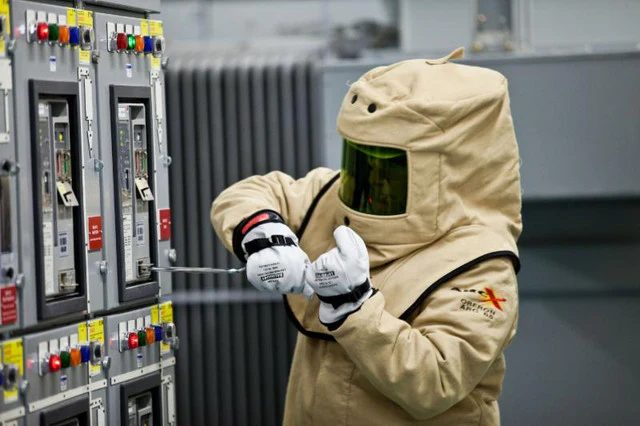
2027 NFPA 70E electrical safety training instructor with students in PPE
30+
Yrs Experience
Per Instructor

A Team of Industry Veterans — Not a Training Vendor

We didn't set out to build a training company. We're career safety professionals and OSHA-credentialed instructors who spent decades on plant floors, in data centers, and on job sites before we ever led a class. Teaching 2027 NFPA 70E is how we now pass on what those years taught us.

Each instructor brings a minimum of 30 years of hands-on industry experience, a CSP credential, and OSHA Authorized Outreach status. Sessions are built around scenario-based group exercises and the equipment your crew actually runs — not a generic slide deck — and every course reflects the current 2027 NFPA 70E standard. We deliver onsite, virtual instructor-led, and hybrid multi-site formats, priced to stay cost-effective as your team grows.

35+ years of hands-on industry experience — every instructor
CSP-credentialed, OSHA Authorized Outreach
Interactive, scenario-based group exercises
Current to the 2027 NFPA 70E standard
Onsite, virtual instructor-led & hybrid formats
Cost-effective pricing at any team size
Fast, nationwide scheduling
Our Full Story →

Where We Work

Our instructors have run 2027 NFPA 70E sessions in data centers, hospitals, manufacturing plants, utilities, cement plants, and active construction sites — each program scoped to that industry's actual hazards.

Data center electrical safety training
Mission-Critical Facilities
Data Centers

Zero room for error. We train crews on the hazards specific to high-density power — switchgear, PDUs, and live equipment — without pulling systems offline to do it.

Data center training →
General industry 2027 NFPA 70E training — manufacturing, utilities, hospitals
Plants, Utilities & Healthcare
General Industry

Plants, utilities, hospitals, and maintenance crews get a program built to OSHA 29 CFR 1910.332/333 and tailored to the electrical hazards actually present on their floor.

General industry training →
Construction 2027 NFPA 70E training — OSHA 1926 Subpart K
OSHA 29 CFR 1926 Subpart K
Construction

Temporary power, overhead lines, and energized systems create risks unique to active job sites. We cover Subpart K requirements for qualified and unqualified crew alike.

Construction training →

Why Teams Choose Us Over a Course Catalog

We don't teach forty different safety topics — 2027 NFPA 70E is the only subject we deliver, and it shows in the outcomes.

Built From Your Facility, Not a Template

We start every program by learning your equipment, your process, and your hazards before a single slide gets written. The scenarios and case studies your team works through come from your world — never a canned deck pulled off a shelf.

Taught by Working Industry Veterans

Every instructor holds a CSP credential and OSHA Authorized Outreach status, backed by 35+ years in the field. You're learning from people who've done the job, not contract presenters reciting someone else's slides.

Outcomes That Are Actually Measured

Our sessions average a 9.46/10 trainee satisfaction score, an 82% recommend-us rate, and a 74.4% perfect-score rate on post-training assessments — proof that training built around real job tasks sticks better than a generic course.

We Come to You, Coast to Coast

There's no franchise territory or regional middleman standing between you and an instructor. We travel anywhere in the U.S. and typically mobilize within two to three weeks of booking, built around your timeline.

Virtual Instructor-Led or Onsite — One Standard

Every format — onsite or virtual instructor-led over Zoom or Teams — uses the same instructor, curriculum, and certification. We don't offer a pre-recorded option; every session is live, interactive, and more cost-effective than flying a team to a classroom.

Documentation That Holds Up in an Audit

Each session generates individual arc flash certifications plus a full documentation package mapped to OSHA 29 CFR 1910 Subpart S and 1926 Subpart K, so your compliance records are organized and ready before an auditor ever asks.

How We Get Your Team Trained

No lengthy sales process — just a short conversation and a program built around your operation.

1

Reach Out

Call (855) 999-0-ARC or send a quote request — most inquiries get a same-day response.

2

We Scope the Job

We walk through your site, workforce, and compliance gaps so the course fits your actual equipment and hazards.

3

You Pick the Format

Choose onsite, virtual instructor-led, or a hybrid across multiple sites — same instructor, same standard, either way.

4

You Get the Paper Trail

Every participant walks away with a completion certificate, and you get the documentation your compliance file needs.

Trusted by Hundreds of Safety-Conscious Teams

2027 NFPA 70E Insights

View All Articles →
Electrician inspecting a breaker panel setting
Compliance
The Breaker Setting Nobody Told the Electrician About

A breaker trip setting changed during a project can quietly invalidate an arc flash label. Here's how a Management of Change process — and 2027 NFPA 70E — are supposed to close that gap before an electrician gets hurt.

July 2026 • 6 min read
Solar PV panels with lockout tagout safety considerations
Industry Focus
Solar PV LOTO: You Can't Lock Out the Sun

Standard lockout/tagout assumes you can fully de-energize a circuit. Solar PV systems break that assumption — the modules keep producing voltage as long as light hits them. Here's what qualified workers need to know.

July 2026 • 7 min read

2027 NFPA 70E Training FAQ

Answers to the questions safety managers and EHS teams ask us most often.

What’s new in the 2027 edition of NFPA 70E?
The 2027 edition — in effect since May 6, 2026 — tightens several requirements employers should know about. Highlights include a new requirement for an additional person trained in emergency response whenever the energized work permit calls for shock or arc flash PPE, a stronger expectation that the emergency response plan is settled before a panel is ever opened, job briefings that cover the specific task’s hazards and required PPE, and a management-of-change expectation that incident-energy analyses are reviewed whenever the electrical system changes — not just on a fixed calendar. Every class we teach is built on the 2027 edition.
What is 2027 NFPA 70E training and who is required to have it? +

2027 NFPA 70E — the Standard for Electrical Safety in the Workplace, published by the National Fire Protection Association — sets the requirements for arc flash hazard analysis, arc flash and shock boundaries, incident energy assessment, PPE selection, and lockout/tagout (LOTO) procedures. Federal OSHA does not explicitly cite NFPA 70E in 29 CFR 1910 Subpart S or 29 CFR 1926 Subpart K, but OSHA enforcement uses it as the recognized industry standard for electrical safety, and employers who follow 2027 NFPA 70E have the strongest available defense under the General Duty Clause: any worker exposed to electrical hazards needs training, whether they are a qualified electrical worker or an unqualified person working near energized equipment.
How often is 2027 NFPA 70E retraining required? +

The standard itself, Section 110.4(A)(4)(a), sets a maximum interval of three years, with retraining required sooner if there's an incident or near-miss, an inspection turns up gaps in knowledge, job tasks or equipment change, or someone's observed working unsafely. In practice, most EHS managers we work with schedule retraining annually rather than waiting for the three-year mark, simply because it keeps safe work practices top of mind.
What is the difference between qualified and unqualified workers under 2027 NFPA 70E? +

A 'qualified electrical worker' under 2027 NFPA 70E has demonstrated the skills and knowledge to recognize arc flash hazards, shock hazards, boundaries, and incident energy levels — and has the training to prove it. 'Unqualified persons' work near energized equipment without being trained electricians: contractors, maintenance staff, or facility personnel, for example. Both groups need training, though the content and depth differ — our programs cover both tracks, including PPE selection and LOTO procedures under OSHA 29 CFR 1910.147.
Does virtual 2027 NFPA 70E training satisfy OSHA requirements? +

It does, as long as it is live and instructor-led. OSHA's requirements under 29 CFR 1910.332/333 (General Industry) and 1926 Subpart K (Construction) are satisfied by virtual training that covers the required content and allows real-time interaction between participants and the instructor — which is exactly how we run every virtual instructor-led session. Nothing pre-recorded, real Q&A throughout, and you get the same certificates and compliance documentation as an onsite class.
How long does 2027 NFPA 70E training take? +

Our full curriculum runs 8 hours and covers arc flash hazard analysis, PPE selection, Lockout/Tagout, and safe work practices from end to end. For workers who have already completed 2027 NFPA 70E training within the last 3 years, a 4-hour refresher covers what has changed. OSHA expects retraining whenever a worker's knowledge is outdated, new equipment or tasks are introduced, or the 3-year mark is reached — we will help you determine which format fits your team's timeline.
What is arc flash and why is 2027 NFPA 70E training required? +

An arc flash is an electrical explosion — a fault current arcing through the air between conductors, or from a conductor to ground — capable of reaching temperatures near 35,000°F, roughly four times hotter than the sun's surface, and releasing heat, pressure, and shrapnel in a fraction of a second. OSHA 29 CFR 1910.132 requires employers to assess electrical hazards and provide the right PPE and training, and 2027 NFPA 70E is the standard that spells out how: how to perform the hazard analysis and what PPE energized work requires.
What PPE is required under 2027 NFPA 70E? +

2027 NFPA 70E sorts PPE into four categories based on incident energy. Category 1 (4 cal/cm² minimum) calls for an arc-rated shirt, pants or coverall, safety glasses, and hearing protection. Category 2 (8 cal/cm² minimum) adds a face shield and hard hat. Categories 3 and 4 (25–40+ cal/cm²) step up to full arc flash suits and hoods. Which category applies comes down to either an incident energy analysis or the PPE tables in NFPA 70E — Tables 130.7(C)(15)(a), (b) and (c) — we cover both in training, along with the boundary requirements that trigger PPE in the first place.
Can you train workers at multiple locations or facilities? +

Yes — multi-site programs are common for us. Onsite, we travel to each facility and tailor the program to that location's equipment and hazards. Virtually, we can run sessions across time zones simultaneously or back-to-back. Either way, clients with multiple sites get one consistent curriculum, standardized documentation, and a single point of contact instead of juggling a different vendor per location.
Do participants receive certificates after training? +

Every participant gets a certificate of completion showing the training date, the instructor's credentials, and what was covered, and employers receive a class roster plus documentation suitable for an OSHA file. Certificates list the instructor's CSP credential and OSHA Authorized Outreach Instructor number, and we keep records on file if you ever need a duplicate copy. Everything arrives in PDF form within 24 hours of the session ending.
How is your training different from online 2027 NFPA 70E courses? +

A self-paced online course cannot replicate real-time Q&A or scenario-based group discussion — and that interaction is what actually makes training stick. Every one of our sessions is live, whether that is onsite or via virtual instructor-led Zoom/Teams delivery, and built around your industry's equipment and hazards so workers can ask about the job in front of them, not a hypothetical. It is also often the more cost-effective route for teams of any size, since one flat-rate session trains an entire group rather than billing per online seat. A pre-recorded course gets you a checked box; our 9.46/10 trainee satisfaction score and 74.4% perfect-score rate reflect something closer to actual behavior change.
What is the maximum class size for 2027 NFPA 70E training? +

We cap every session, onsite or virtual, at 20 participants. That is deliberate: smaller groups mean real discussion, better engagement, and the ability to tailor examples to the specific workers in the room instead of lecturing at a crowd. If your headcount is bigger than 20, we simply run additional sessions so nobody loses that small-group benefit.
What does arc flash safety training actually cover? +

Arc flash training under 2027 NFPA 70E covers the hazard itself — the intense heat, light, pressure wave, and shrapnel released when a fault current arcs through the air — plus how to recognize the arc flash boundary and shock approach boundaries, how PPE is selected for the incident energy at hand, and the safe-work practices (job briefings, energized work permits, lockout/tagout) that keep qualified and unqualified persons alike out of harm's way. Our arc flash training is always live and instructor-led, onsite or virtual, so questions get answered in real time rather than clicked past.


Ready to Schedule Training
for Your Team?

We respond to every inquiry within 24 hours — usually same day. Tell us your industry, location, team size, and timeline and we’ll build a program around your team, your industry, and your timeline.