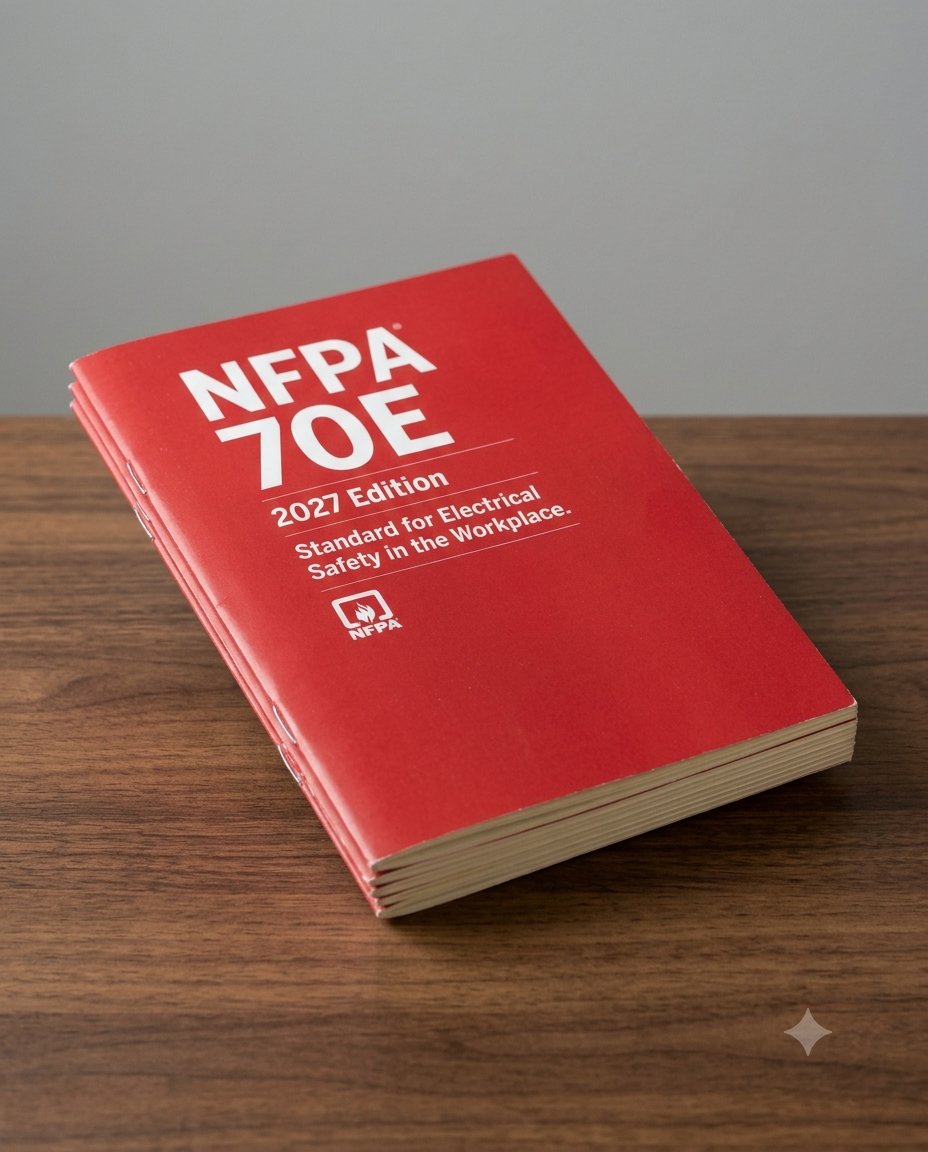
Here is the short version. NFPA 70E training is required for anyone who is exposed to electrical hazards on the job — and it is what turns an electrician or technician into a qualified person who may work on or near energized equipment. Retraining is required at intervals not to exceed three years, and sooner when tasks, procedures, equipment, or observed performance say so. OSHA does not name NFPA 70E in its rules, but it measures employers against it. The rest of this article unpacks each of those sentences on the current standard: the 2027 edition of NFPA 70E, in effect since May 6, 2026.
Who actually needs NFPA 70E training
The standard's dividing line is exposure to electrical hazards, not job title. In practice the training requirement lands on three groups:
- Qualified persons — electricians, maintenance techs, controls engineers, anyone who works on or near exposed energized conductors or circuit parts. A qualified person is someone who has demonstrated skills and knowledge related to the construction and operation of the equipment and has received safety training on the hazards involved. Note both halves: training plus task-specific demonstration. A card in a wallet does not make someone qualified on gear they have never seen.
- Workers who face exposure without doing electrical work — operators who rack breakers, facilities staff who reset equipment, supervisors who authorize work. They need training scaled to their exposure so they can recognize hazards and stay outside the boundaries.
- The people who run the program — safety managers and supervisors who sign energized electrical work permits and job briefings need to understand what they are signing.
What the training has to cover in 2027
Training on a superseded edition is a real and common failure. The 2027 edition has been the standard in effect since May 6, 2026, and it changed things a class must now teach:
- The additional-person requirement (new 130.2(A)(2)). When an energized electrical work permit specifies shock or arc flash PPE, at least one additional person — trained in emergency response under 110.4(C)(1) — must be positioned outside the limited approach boundary or the arc flash boundary, whichever is greater. Standby rescue, not a second set of hands.
- Emergency response planning before the work. Who is trained in contact release, where the rescue hook and AED are, who calls for help, and how EMS actually gets to the gear — settled before a panel is opened.
- Job briefings that protect the person. Incident energy at the point of work, the PPE that number demands, where the boundaries fall, energy-source control, and the emergency plan.
- Management of change. The incident-energy analysis is expected to be reviewed when the electrical system changes — fault current, protective-device settings, clearing times — not just on a fixed calendar. An arc flash label is a snapshot of the system as studied.
- The fundamentals, on current terms. Shock protection uses the limited and restricted approach boundaries; the arc flash boundary is where incident energy falls to 1.2 cal/cm². If a course still teaches a "prohibited approach boundary," it is teaching a concept removed from the standard in 2015 — walk away.
Training on the 2027 edition — live, every week
Live instructor-led NFPA 70E training, current to the 2027 edition, taught by a Certified Safety Professional. Virtual seats weekly, onsite nationwide.
See Virtual TrainingHow often: the three-year rule and its four exceptions
Retraining is required at intervals not to exceed three years. Three years is the ceiling, not the schedule — four triggers require retraining sooner:
- Job tasks or equipment change. New gear, new voltage class, new responsibilities.
- Procedures change. If your electrical safety program or written procedures are revised, the people executing them get retrained on the revisions.
- An incident or near-miss occurs. An event is evidence the current training did not hold.
- Observed performance shows a deficiency. If a supervisor watches someone skip a verification step, that observation — not the calendar — starts the clock.
The practical consequence: a compliant program needs someone watching work practices between classes, because two of the four triggers only fire if somebody is looking.
Don't confuse the three clocks
Three different review intervals live in a 70E program, and mixing them up is one of the most common program errors we see in class:
- Worker retraining — every 3 years (or sooner, per the triggers above).
- Electrical safety program review — every 3 years. The written program itself gets audited on its own clock. Same number, different object.
- Arc flash risk assessment / label review — every 5 years, and additionally whenever the system changes (management of change). Labels get reviewed at least every five years; the program every three; the people every three.
What OSHA expects
OSHA does not adopt NFPA 70E by name. It enforces electrical safety through Subpart S and the General Duty Clause, and uses NFPA 70E as the recognized industry standard — the measure of what a reasonable employer would have done and the feasible means of abatement. So "is 70E training legally required?" has a practical answer: if your people are exposed to electrical hazards and untrained, OSHA will measure you against 70E after the incident. The full relationship — what Subpart S actually says, how the General Duty Clause works — is covered in our companion piece, OSHA and NFPA 70E in 2027.
Choosing a class that satisfies the requirement
Three questions sort the market fast. Which edition does it teach? The answer must be 2027, without hesitation. Is there a live instructor? Qualification requires demonstrated understanding, which is hard to build clicking "next" on a recording — our breakdown of what a good NFPA 70E class covers goes deeper. Does it fit how your people actually work? Live-virtual weekly classes cover individuals and small crews without travel; onsite classes make sense when you are training a whole crew on your own gear.
Frequently asked questions
Is NFPA 70E training required by law?
Not by name. OSHA enforces electrical safety through Subpart S and the General Duty Clause and treats NFPA 70E as the recognized standard of care — which makes 70E training the practical way to meet the legal duty.
How often does NFPA 70E training expire?
Retraining is required at intervals not to exceed three years — sooner if tasks or equipment change, procedures change, an incident or near-miss occurs, or observed performance shows a deficiency.
Who counts as a qualified person?
Someone who has demonstrated skills and knowledge related to the construction and operation of the specific equipment and has received safety training on the hazards involved. Qualification is established by training plus task-specific demonstration, and it is equipment-specific.
Do office or non-electrical staff need it?
Anyone exposed to electrical hazards needs training scaled to that exposure. A worker who never approaches exposed energized parts needs far less than a qualified person — but operators, facilities staff, and supervisors who authorize work are commonly inside the requirement.
Did the 2027 edition change training requirements?
The 2027 edition (in effect since May 6, 2026) added content training must now cover — most notably the additional-person requirement in 130.2(A)(2), tightened expectations for emergency response planning and job briefings, and management-of-change review of the incident-energy analysis.
Rick Hauf, CSP is a Certified Safety Professional with 35+ years in EHS and electrical safety. He teaches NFPA 70E nationwide - roughly 25 classes a year to electricians, EHS professionals, and Fortune 500 operators including hyperscale data centers, manufacturers, and utilities - with attendee ratings averaging 9.7/10. This article reflects the 2027 edition of NFPA 70E.