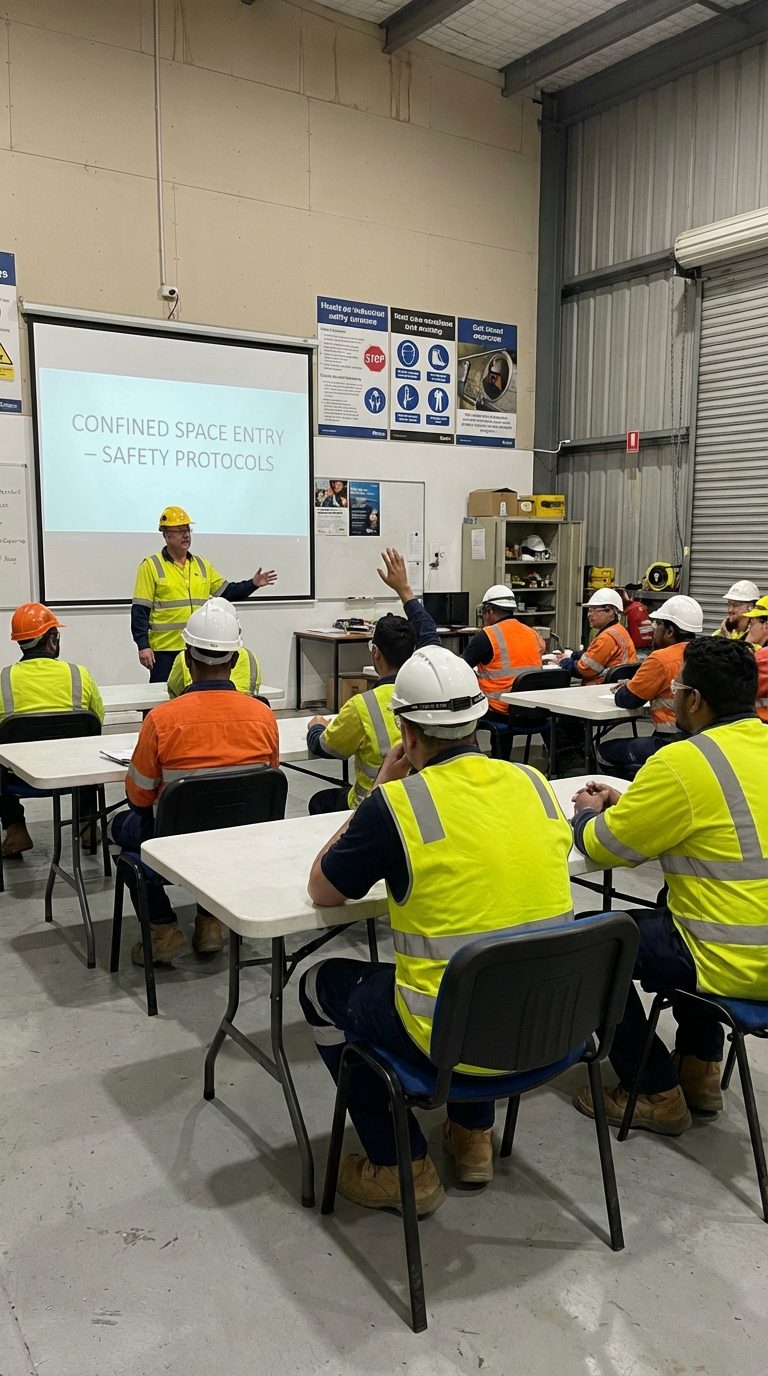
Does NFPA 70E train-the-trainer work? Honest answer: yes — under conditions most organizations don't check before they buy it. The model — send one of your own people to be prepared as an instructor, then deliver electrical safety training in-house — works well when you have a large, stable headcount to train, real dedicated time for the trainer, and strong ownership of the electrical safety program. It fails, quietly and predictably, when the trainer's material drifts, when nobody refreshes the curriculum after the standard changes, or when the trainer can't hold the room. I've seen internal programs better than anything a road instructor could deliver — and internal programs still teaching an edition two cycles old. This guide is about telling those two futures apart before you commit.
What "train the trainer" actually means here
In the electrical safety market, NFPA 70E train-the-trainer (you'll also see arc flash train the trainer — same product) usually means an intensive course that prepares an internal employee, typically a senior electrician or EHS professional, to deliver NFPA 70E training to the rest of the workforce. The graduate comes home with a certificate, slide decks, and sometimes licensed courseware.
One thing to be clear-eyed about from the start: NFPA 70E does not certify trainers. There is no trainer credential in the standard, and no rule that says training must come from any particular kind of instructor. What the standard cares about is the outcome — workers exposed to electrical hazards are trained, and qualified persons have demonstrated skills and knowledge of the equipment's construction and operation plus safety training on the hazards, established by training and task-specific demonstration. A train-the-trainer certificate is a market product. It can be a good one. It is not, by itself, compliance.
When it genuinely works
The successful internal programs I've seen share three traits, and all three matter.
1. A large, stable headcount to train
Train-the-trainer is an economy-of-scale decision. If you're training dozens of people a year across shifts — new hires, transfers, the three-year retraining cycle — an internal trainer amortizes fast and schedules around production, not an outside instructor's calendar. Training eight electricians every three years? The math rarely closes, and the trainer's skills go stale between deliveries.
2. Real, dedicated trainer time
The failed programs almost all made the same move: they bolted "trainer" onto a full workload and gave the person no hours for it. Preparing a class, keeping current with the standard, and actually teaching is real work. If it isn't in the job description with time attached, it will lose every scheduling conflict it enters.
3. Strong program ownership
An internal trainer succeeds inside a living electrical safety program — one where someone owns the written program, watches work practices between classes, and treats a near-miss as a retraining trigger rather than a filing exercise. That matters because the retraining rule has teeth: retraining is required at intervals not to exceed three years, and sooner when job tasks or equipment change, procedures change, an incident or near-miss occurs, or observed performance shows a deficiency. Two of those four triggers only fire if somebody is looking. An internal trainer embedded in a program that looks is a genuine advantage over any outside instructor — they're there the day the deficiency is observed. The full retraining picture is laid out in our guide to NFPA 70E training requirements.
Where it fails — four failure modes I keep seeing
Trainer drift
The course delivered in year four is not the course the trainer was taught in year one. Slides get trimmed, hard exercises get dropped, war stories replace demonstrations, and nobody audits the delivery. Drift is invisible from the safety office because attendance records still look perfect.
No refresh pipeline when the standard changes
This is the failure mode with the sharpest current example. The 2027 edition of NFPA 70E has been in effect since May 6, 2026, superseding the 2024 edition — and it added material an internal curriculum built even two years ago simply does not contain. The clearest case is the new additional-person requirement in 130.2(A)(2): when an energized electrical work permit specifies shock or arc flash PPE, at least one additional person must be present — trained to the emergency-response requirements of 110.4(C)(1) (release from contact, CPR, summoning help) and positioned outside the limited approach boundary or the arc flash boundary, whichever is greater. That person is standby rescue, not a second set of hands on the task. An internal program with no pipeline for edition changes will keep teaching the old world with complete confidence, because the trainer was certified once and the certificate doesn't expire on the wall.
The credibility gap
Adult electricians are a tough room. An outside instructor arrives with the presumption of expertise; an internal trainer arrives as the coworker from building two. The right pick — a respected senior hand whose scars are known — commands the room anyway. The wrong pick, however technically sound, gets polite attendance and zero behavior change. Be honest about who you're nominating and why.
The trainer qualification burden
Your trainer is also a worker on the three-year clock. They need their own retraining at intervals not to exceed three years — sooner on the same four triggers as everyone else — and they need it from outside the loop they run, or the program is grading its own homework. Budget for the trainer's ongoing education as a permanent line item, not a launch cost.
Need an outside anchor for your internal program?
We teach NFPA 70E 2027-edition classes onsite nationwide — on your gear, with your crew — and plenty of clients use that class as the periodic external benchmark for their in-house training.
See Onsite TrainingWhat your trainer has to be able to teach in 2027
Whoever stands in front of your crew — internal or external — the curriculum has to reflect the standard actually in effect. On the 2027 edition, that means at minimum:
- Qualification done properly. A qualified person has demonstrated skills and knowledge of the specific equipment's construction and operation plus safety training on the hazards — training and task-specific demonstration, per person, per equipment class.
- The additional-person rule. The new 130.2(A)(2) requirement above, including who counts (someone with the 110.4(C)(1) emergency-response training) and where they stand (outside the greater of the limited approach boundary or arc flash boundary).
- Job briefings that carry weight. The 2027 edition expects the briefing to cover the specific task: the incident energy at the point of work, the PPE that number demands, where the boundaries fall, how energy sources are controlled, and the emergency plan.
- Emergency response settled before work begins. Contact release, CPR coverage, how help gets summoned and how it physically reaches the gear — decided before the panel opens, not improvised after.
- The OSHA relationship, stated honestly. OSHA enforces electrical safety through Subpart S and the General Duty Clause and uses NFPA 70E as the recognized industry standard. A trainer who tells the class the standard itself is federal law is teaching a myth; a trainer who explains how OSHA measures employers against 70E after an incident is teaching the truth.
If you're evaluating a train-the-trainer vendor, test their curriculum against that list — the same way you'd vet any course using our checklist of what a good NFPA 70E class covers. A vendor still shipping pre-2027 courseware is selling your trainer a head start on being out of date.
The hybrid most organizations actually land on
It's worth saying plainly that this isn't a binary choice. In practice, many organizations pair an outside instructor-led class — commonly on a cycle that matches their retraining clock — with internal reinforcement in between: toolbox talks, job-briefing coaching, equipment-specific demonstrations run by a senior hand. The outside class keeps the curriculum current and independent; the internal layer keeps it alive on the floor between classes. For distributed crews, a live virtual class often serves as that external anchor without anyone traveling. The pure in-house model and the pure outside model are both rarer than the blend — and the blend sidesteps most of the failure modes above, because the parts check each other.
Implementation: building a train-the-trainer program that holds up
If the conditions fit and you're going ahead, sequence it like this:
- Pick for the room, not the resume. Choose someone with field credibility and the temperament to teach — then verify they're current as a qualified person themselves, with the demonstration piece documented.
- Write the role down. Trainer duties, allocated hours, and a delivery calendar go in the job description. Unfunded training programs are the ones that drift.
- Send them to a current-edition course. Whatever program prepares them must teach the 2027 edition — ask the vendor directly which edition the courseware reflects and when it was revised.
- Build the refresh pipeline on day one. Calendar the trainer's own outside retraining (three-year ceiling, sooner on the triggers), and name a standing rule: when a new edition of NFPA 70E takes effect, the internal curriculum is frozen until it's been updated and the trainer refreshed.
- Keep the employer's records, not just the trainer's. Rosters, dates, curriculum version, edition taught, and the task-specific demonstrations that make each person qualified. If it isn't documented, it didn't happen — and after an incident, someone will ask.
- Audit the delivery. Once a year, have someone outside the program sit through the class against the current-edition checklist. This is the cheap insurance against drift, and almost nobody buys it.
- Schedule an external benchmark. Periodically put the crew (trainer included) through an outside class and compare. If the internal program is better, you've proven it; if not, you found out before an incident did.
Frequently asked questions
Does NFPA 70E require or recognize train-the-trainer certification?
No. The standard doesn't certify trainers and doesn't require a particular trainer credential. Train-the-trainer certificates are a market product. What the standard requires is that exposed workers are trained and that qualified persons are established by training plus task-specific demonstration — and the employer owns those decisions and their documentation.
How often does an internal trainer need to refresh their own training?
The same rule as everyone else: intervals not to exceed three years, and sooner when tasks or equipment change, procedures change, an incident or near-miss occurs, or observed performance shows a deficiency. Practically, an edition change is the moment the refresh matters most — the 2027 edition has been in effect since May 6, 2026, and a trainer certified against the prior edition is teaching a superseded standard until they update.
Can an internal trainer make workers qualified persons?
The trainer delivers training; the employer makes people qualified. Qualification requires demonstrated skills and knowledge of the specific equipment plus safety training on the hazards — so after the classroom, someone still has to evaluate and document each person's task-specific demonstration on the actual gear. An internal trainer is well placed to run that step, which is one of the model's real strengths.
What did the 2027 edition change that an internal curriculum must add?
The headline addition is the additional-person requirement in 130.2(A)(2), described above — standby rescue positioned outside the greater boundary whenever the permit specifies shock or arc flash PPE. The 2027 edition also expects the emergency response plan settled before work begins and job briefings covering the task's incident energy, PPE, boundaries, energy-source control, and emergency plan.
Is arc flash train-the-trainer the same thing?
In the market, yes — the phrases are interchangeable. Either way, the program should span the full NFPA 70E scope: shock protection, arc flash protection, qualification, and the program elements around them.
Rick Hauf, CSP is a Certified Safety Professional with 35+ years in EHS and electrical safety. He teaches NFPA 70E nationwide - roughly 25 classes a year to electricians, EHS professionals, and Fortune 500 operators including hyperscale data centers, manufacturers, and utilities - with attendee ratings averaging 9.7/10. This article reflects the 2027 edition of NFPA 70E.