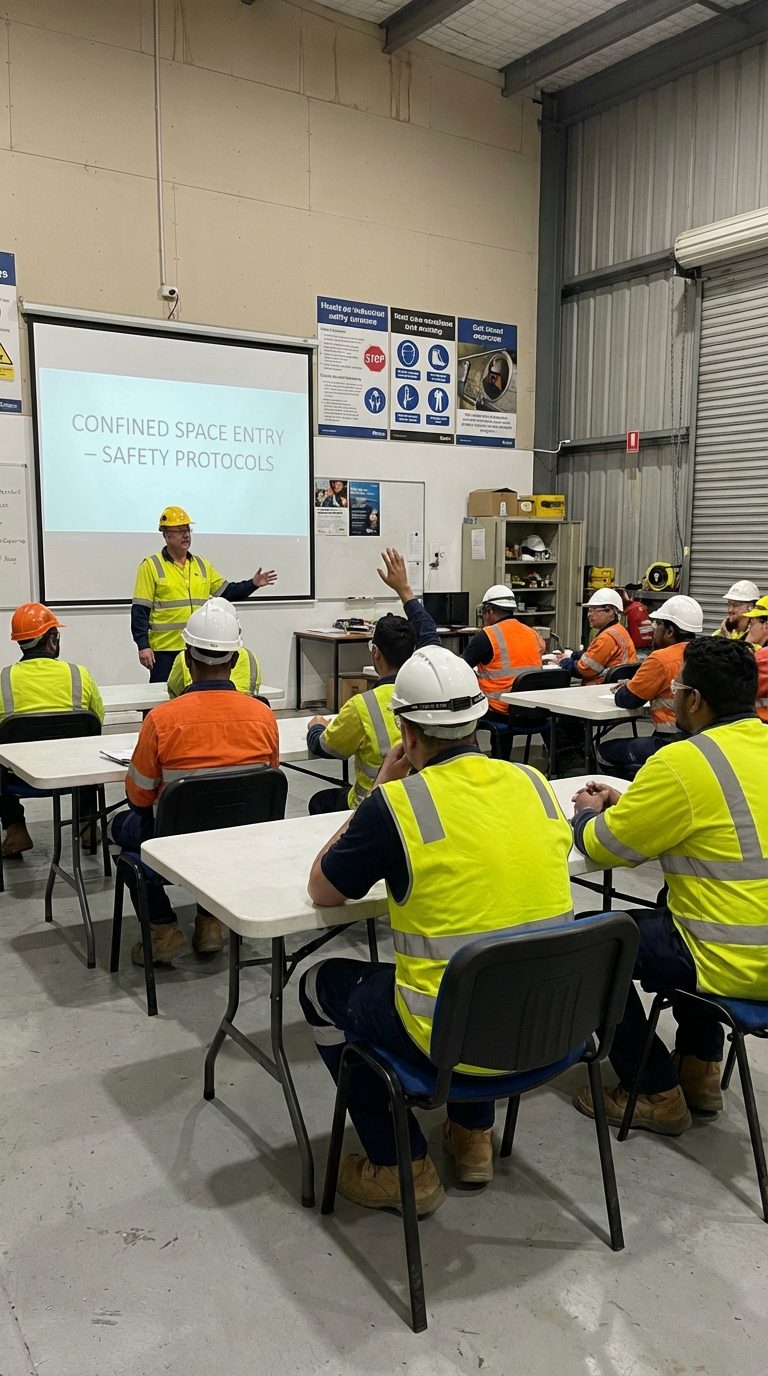
Short answer: your standby person is whoever on the crew currently holds emergency-response training under 110.4(C)(1) — release from contact, CPR, and summoning help — and is available, task by task, to stand outside the boundary instead of inside it. That's not a title most facilities have assigned to anyone before. Under the 2027 edition of NFPA 70E (in effect since May 6, 2026, superseding 2024), new section 130.2(A)(2) makes that person a hard requirement on every energized electrical work permit that specifies shock or arc flash PPE. If you're building or auditing your training program this year, the standby role is the piece most likely to have a gap behind it — not because employers disagree with the rule, but because "who is trained for this" is a question a lot of programs haven't had to answer before.
This isn't a walkthrough of what the rule says — we cover that in detail elsewhere. This is the training-buyer question: who on your roster can actually fill this role today, how many of them you need, and how the training gets built.
The role isn't "another body in the room"
The instinct in a lot of shops is to treat the additional person as a scheduling problem — pull whoever's free, put them near the panel, check the box. That instinct is exactly what the 2027 edition is designed to close off. The additional person is a standby rescuer with a specific job: safely release a worker from contact with an energized conductor, begin CPR, and summon emergency help. They are not a second set of hands on the task, and they are not positioned inside the boundary with the qualified person. If the rule is satisfied by a warm body standing nearby with no training and no assigned role, it isn't actually satisfied.
That distinction matters for training because it means the standby person needs a specific, checkable skill set before they're named on a permit — not just tenure or a general safety background. Someone can be an excellent electrician and still not meet 110.4(C)(1) if their emergency-response training has lapsed or was never delivered.
Why this usually means training more than one person
Here's where a lot of programs get surprised. Training one person to standby-qualified status looks like it solves the requirement — until you map it against an actual work calendar. A single trained standby person is a single point of failure for every permitted energized task on every shift:
- Shifts rotate. If your only trained standby person works days, permitted energized work on nights either waits for them or runs without a compliant rescuer.
- Crews rotate. The person who's free to stand outside the boundary changes task to task. If the standby role always falls to whoever happens to be available, you need training depth across the group, not one designated name.
- People take vacation, get sick, and change jobs. A training roster with one name on it has an expiration date the moment that person is unavailable.
The practical implication: treat 110.4(C)(1) emergency-response training as a coverage question, not a checkbox. How many permitted energized tasks does your site run in a typical week, across which shifts, and how many currently-trained people do you have available to fill the standby role for each one? If the honest answer is "one, maybe two," that's a training gap before it's ever a compliance gap.
Build standby-role coverage into your next class
Live, instructor-led NFPA 70E training on the current 2027 edition — including the 110.4(C)(1) emergency-response content the standby role requires. Virtual seats weekly, onsite nationwide.
See Virtual TrainingDoes this need its own class, or does it fit inside NFPA 70E training?
For most facilities, the 110.4(C)(1) content belongs inside the same NFPA 70E class that trains your qualified persons — not as a separate program. The audiences overlap: the people best positioned to serve as standby rescuers are the same electricians, maintenance techs, and EHS staff who already need current 70E training for their own qualified-person status. Delivering both in one class means you're not scheduling and tracking two separate training tracks for largely the same roster.
Where it can make sense to give the standby-person material its own emphasis is when the numbers don't line up cleanly — for example, a site with more shifts than trained qualified persons, where you need additional people covering standby duty who don't necessarily need full qualified-person depth on every piece of equipment. In that case, a facility might run its core qualified-person class for the crew that does the electrical work, and add emergency-response-focused sessions for a wider group who only need to be able to fill the standby role. Either approach can work; what matters is that someone has actually mapped who's covered against who's needed, rather than assuming the requirement takes care of itself because "we did 70E training this year."
Can your team answer yes to these questions?
This isn't a compliance checklist to file away — it's a gut check for whoever runs training and scheduling. If any answer is no, that's the gap to close before the next audit or, worse, the next incident.
- Do you know, by name, who on each shift currently holds 110.4(C)(1) emergency-response training? Not "someone probably does" — an actual list.
- Is that list long enough to cover a normal week of permitted energized work without relying on one person? If your only trained standby person is out, does energized work stop, or does it proceed non-compliantly?
- Do your permit forms have a place to name the standby person and confirm their training is current — separate from naming the qualified worker performing the task?
- Does your job briefing actually walk through where the standby person will stand and what they'll do, before the permit is signed — not just as a line item read off a form?
- Is standby-person training tracked on the same retraining clock as your qualified-person training — not to exceed three years, sooner if triggered — rather than treated as a one-time event?
Five questions, and most programs can answer the first two or three without much trouble. It's usually the third and fourth — the permit form and the briefing habit — where the gap between "we trained someone" and "the rule is actually satisfied" shows up.
What this doesn't require
Worth being direct about the boundaries here, because it's easy to over-scope this. The standby role does not require paramedic-level medical training, a separate certification body, or a dedicated safety officer hired specifically for this function. It requires the emergency-response training described in 110.4(C)(1) — contact release, CPR, summoning help — delivered to enough of your existing crew that the role can actually be filled, task after task, without depending on one irreplaceable person. That's a training and scheduling problem your program can solve directly, not a new department you have to stand up.
Frequently asked questions
Does a standby person need a full NFPA 70E qualified-person course?
Not necessarily. The 2027 rule requires the emergency-response training of 110.4(C)(1) — contact release, CPR, and summoning help — which is narrower than full qualified-person training on construction, operation, and hazards of specific equipment. In practice, most crews build the standby person's emergency-response training into the same NFPA 70E class that trains their qualified persons, since the audience overlaps heavily. Whether a facility needs a standalone emergency-response session on top of that depends on how many people rotate through the standby role and how current their training is.
Can the same person be the standby rescuer every time?
Only if that person is available for every permitted energized task on every shift — which is rarely realistic. One trained standby person creates a single point of failure: if they are on vacation, out sick, or already assigned to another task, permitted energized work either waits or runs without a compliant standby. Most programs need more than one person trained per crew or shift to keep the role covered.
Can the standby person also work on the task?
No. Under 130.2(A)(2), the additional person is a dedicated standby rescuer positioned outside the limited approach boundary or the arc flash boundary, whichever is greater — not a second set of hands inside the boundary. A helper working alongside the qualified person inside the boundary is exposed to the same event and cannot serve as the rescuer for that event.
How often does standby-person training need to be renewed?
NFPA 70E sets retraining intervals not to exceed three years, with retraining required sooner if job tasks or equipment change, procedures change, an incident or near-miss occurs, or observed performance shows a deficiency. A standby person's emergency-response training is subject to the same clock — it has to be current at the moment they are named on the permit, not merely completed at some point in the past.
Does OSHA require standby-person training?
OSHA does not name NFPA 70E or its standby-person requirement directly. It enforces electrical safety through Subpart S and the General Duty Clause and treats NFPA 70E as the recognized industry standard for protecting workers from electrical hazards. A program that trains and staffs the 2027 additional-person requirement is using the method OSHA points to.
For the full technical breakdown of the 2027 rule — the permit mechanics, boundary determination, and documentation requirements behind the standby role — see 70eguide.com's guide to the additional-person requirement. This article covers the training side: who fills the role and how to build that capability into your program. For the requirements around who needs NFPA 70E training generally and how often, see our companion piece on NFPA 70E training requirements.
Rick Hauf, CSP is a Certified Safety Professional with 35+ years in EHS and electrical safety. He teaches NFPA 70E nationwide — roughly 25 classes a year to electricians, EHS professionals, and Fortune 500 operators including hyperscale data centers, manufacturers, and utilities — with attendee ratings averaging 9.7/10. This article reflects the 2027 edition of NFPA 70E.