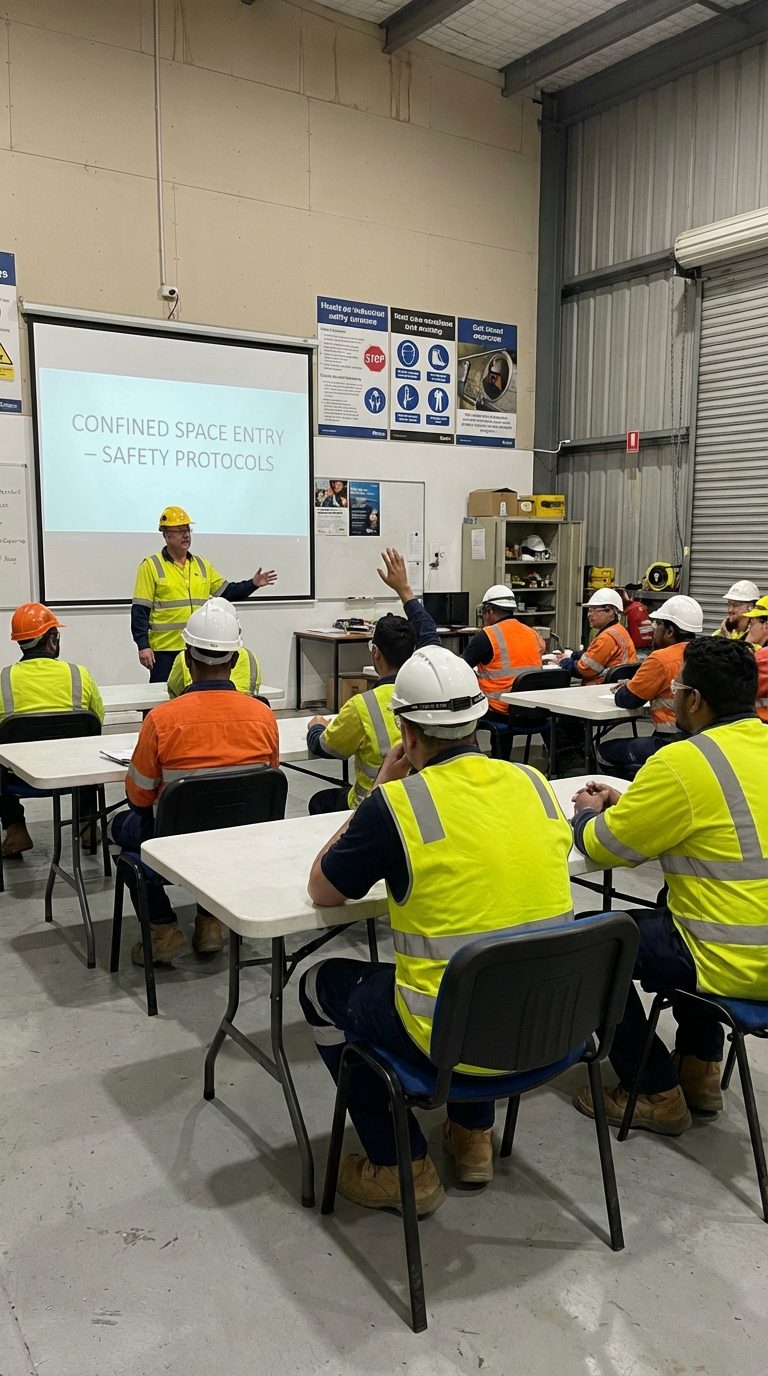
What does qualified electrical worker training actually have to accomplish? Under NFPA 70E, a qualified person is someone who has demonstrated skills and knowledge related to the construction and operation of the electrical equipment and installations involved, and has received safety training on the hazards — and qualification is established by training plus task-specific demonstration. Two things in that definition trip up most organizations. First, training is only half of it: a class, however good, delivers the safety-training piece and nothing else. Second, nobody sells qualification — the employer makes the determination and owns the evidence behind it. I've reviewed plenty of programs that treated a course certificate as a qualification credential; after an incident, that gap is the first thing anyone finds. Here's what a defensible program actually contains on the current 2027 edition.
What "qualified" means under NFPA 70E — and what it doesn't
The definition has three load-bearing parts, and a program has to satisfy all three:
- Demonstrated skills and knowledge of the construction and operation of the equipment and installations the person will work on — not electrical theory in general, the actual gear.
- Safety training on the hazards involved — shock, arc flash, the boundaries and controls that go with them.
- Established by training plus task-specific demonstration — the person shows, on real tasks, that the training landed.
Notice what's absent. There is no license called "qualified electrical worker" — no hour count, no national registry, no card that transfers between employers. A journeyman's license, an engineering degree, twenty years in the trade: all evidence, none of it qualification by itself. I've met licensed electricians unqualified for the switchgear in front of them, and unlicensed operators thoroughly qualified for the narrow tasks their employer had trained, tested, and documented. If the vocabulary is fuzzy in your program, start with our breakdown of qualified vs. competent person — the terms are not interchangeable, and OSHA uses "competent person" to mean something else entirely.
The employer makes the call — not the training company
This is the point I make in every class, usually to visible discomfort in the managers' row: I cannot make your people qualified. Neither can any other instructor. A provider can deliver current, rigorous training and honest documentation of it. The determination that a specific worker is qualified for specific tasks on specific equipment belongs to the employer — only the employer knows the gear, the tasks, and the person's demonstrated performance on both. Programs fail here predictably: they outsource the training, file the certificates, and never build the second half.
Why training alone doesn't make anyone qualified
The demonstration requirement isn't bureaucratic decoration — it's the difference between knowing about a hazard and being safe around one. A worker can pass a written exam and still not identify where the limited and restricted approach boundaries fall on the equipment they open every week. They can recite the definition of incident energy — the thermal energy at a working distance from an arc, in cal/cm², driven by available fault current and clearing time — and still pick the wrong PPE because they never practiced reading a label under supervision.
Demonstration is also what makes qualification honestly scoped. Because it's task-specific, a worker who has demonstrated skills on 480 V motor control equipment has demonstrated nothing about medium-voltage switchgear — and a program treating one class plus one demonstration as blanket qualification for "everything electrical" is writing a check the evidence can't cash.
The three legs of a real qualification program
1. Safety training on the hazards
Classroom or live-virtual instruction covering shock and arc flash hazards, the boundary system, PPE selection logic, and the program elements around energized work. This is the part you can buy — and the part where currency matters most, because the curriculum has to reflect the edition actually in effect (more on 2027 below).
2. Task demonstration on the actual equipment
A designated evaluator watches the worker perform the tasks they'll be qualified for — on the employer's own gear or a faithful equivalent — and judges the performance against the procedure. This is the half no vendor can deliver from a hotel ballroom, and the half most often missing from the programs I audit. It doesn't need to be elaborate; it needs to be real, per task, and recorded.
3. Documentation that survives scrutiny
Who was trained, on what curriculum, reflecting which edition, on what date, by whom — and who demonstrated which tasks, on what equipment, evaluated by whom. If the records can't answer those questions for a named worker, the program can't prove that worker was qualified on the day it mattered.
The training leg, handled — current to the 2027 edition
We deliver NFPA 70E qualified-worker training nationwide on the 2027 edition — onsite on your gear, or live-virtual for distributed crews. You keep the employer's role; we make the training half airtight.
See Live Virtual TrainingThe retraining clock: three years is the ceiling, not the schedule
Qualification is not permanent. Retraining is required at intervals not to exceed three years — and sooner whenever any of four triggers fires:
- Job tasks or equipment change — new switchgear, a new duty assignment.
- Procedures change — the written program or task procedures are revised.
- An incident or near-miss occurs — including the ones nobody wrote up.
- Observed performance shows a deficiency — a trigger that only exists if someone is watching.
Two of those four triggers — incidents and observed deficiencies — require an active program between classes. Treat three years as the schedule rather than the ceiling, and the trigger that should fire most often never fires at all. An edition change should also restart the clock early: the 2027 edition has been in effect since May 6, 2026, superseding 2024, and it added requirements a pre-2027 curriculum simply does not contain. The full picture — who needs training, the intervals, the review clocks employers confuse — is in our guide to NFPA 70E training requirements.
What 2027-current qualified worker training has to cover
Whoever delivers your electrical hazard training — outside instructor or an in-house trainer built through a train-the-trainer program — test the curriculum against this list. A 2027-trained qualified worker should be able to work with all of the following:
- The boundary system. Shock protection built on the limited and restricted approach boundaries, plus the arc flash boundary — the distance at which incident energy falls to 1.2 cal/cm², the onset of a curable second-degree burn, inside which arc-rated PPE is required.
- PPE selection, both methods. The table method's likelihood-based PPE categories — four, with minimum arc ratings of 4, 8, 25, and 40 cal/cm² — versus the incident-energy-analysis method, and why a facility uses one or the other for a given task, never both at once.
- The additional-person rule — new in 2027. Under 130.2(A)(2), when the energized electrical work permit (now found at 130.3) specifies shock or arc flash PPE, at least one additional person is required — trained to the emergency-response requirements of 110.4(C)(1) (release from contact, CPR, summoning help) and positioned outside the limited approach boundary or the arc flash boundary, whichever is greater. A second set of hands inside the boundary does not satisfy this; the additional person is standby rescue, not a task participant.
- The emergency response plan, settled before the work. The 2027 edition presumes a real plan before a panel is opened: who is trained in contact release, where the rescue hook and AED are, who calls for help, and the actual inbound path for EMS — a pointed question in secured facilities, where badge readers and mantraps can stand between a paramedic and your worker.
- Job briefings that protect the person, not just the load. A briefing built on the specific task: the incident energy at the point of work, the PPE that number demands, where the boundaries fall, energy-source control, and the emergency plan — including where the additional person stands.
Where OSHA fits
The question I get in every class: "Is NFPA 70E law?" OSHA does not adopt NFPA 70E by name; it enforces electrical safety through Subpart S and the General Duty Clause, and uses NFPA 70E as the recognized industry standard — the measure of what a reasonable employer would have done and the feasible means of abatement. After an incident, your qualification program is what gets measured against that standard: was this worker trained, was the training current, could the employer show demonstrated skills for the task being performed? A stack of three-year-old certificates with no demonstration records answers the reasonable-employer question the hard way.
Implementation: building the qualification program
If you're standing a program up — or repairing one that's really just a training calendar — sequence it like this:
- Inventory tasks and equipment first. List the equipment classes in the facility and the electrical tasks each role actually performs. You qualify people against this list, not against "electricity."
- Decide who needs to be qualified at all. Workers who face electrical hazards need electrical hazard training; only those performing tasks that require it need full qualification. Match the roster to the task list.
- Deliver 2027-edition training. Verify the curriculum covers the items above — ask the vendor directly which edition the courseware reflects and when it was revised.
- Run the demonstrations. For each person, each qualified task: performance observed by a designated evaluator on the actual equipment, judged against the written procedure, pass or remediate.
- Document all of it. Rosters, dates, curriculum version, edition taught, evaluator names, task-by-task results. The test: could you prove a named worker was qualified for the task they were performing on a specific date?
- Put the sooner-triggers on somebody's job description. The three-year ceiling takes care of itself; the four triggers need an owner who watches work practices, hears about near-misses, and can pull a worker back into training.
- Restart on edition changes. When a new edition takes effect — as 2027 did on May 6, 2026 — treat the curriculum as stale until updated and delivered. The workers haven't lost their skills, but the program can no longer show their training covers the requirements now in force.
Frequently asked questions
What is a qualified electrical worker under NFPA 70E?
Someone who has demonstrated skills and knowledge related to the construction and operation of the electrical equipment and installations involved, and has received safety training on the hazards — established by training plus task-specific demonstration. The employer makes the determination and owns the documentation.
Does completing an NFPA 70E class make someone qualified?
No. A class delivers the safety-training half. The other half — demonstrated skills on the actual equipment, evaluated and documented by the employer — can't be bought from any provider. A course certificate is evidence of training, not a qualification credential.
How often do qualified electrical workers need retraining?
At intervals not to exceed three years — and sooner when job tasks or equipment change, procedures change, an incident or near-miss occurs, or observed performance shows a deficiency. Three years is the ceiling; the sooner-triggers are the working part of the rule.
Can a worker be qualified for some equipment and not others?
Yes — in practice that's the normal condition. Because qualification is established by task-specific demonstration, it attaches to the equipment and tasks the person has actually demonstrated. Track it per person, per equipment class and task.
Does OSHA require qualified electrical worker training?
OSHA does not adopt NFPA 70E by name. It enforces electrical safety through Subpart S and the General Duty Clause, and uses NFPA 70E as the recognized industry standard — the measure of what a reasonable employer would have done. After an incident, your training and qualification records are held up against that measure.
Rick Hauf, CSP is a Certified Safety Professional with 35+ years in EHS and electrical safety. He teaches NFPA 70E nationwide - roughly 25 classes a year to electricians, EHS professionals, and Fortune 500 operators including hyperscale data centers, manufacturers, and utilities - with attendee ratings averaging 9.7/10. This article reflects the 2027 edition of NFPA 70E.