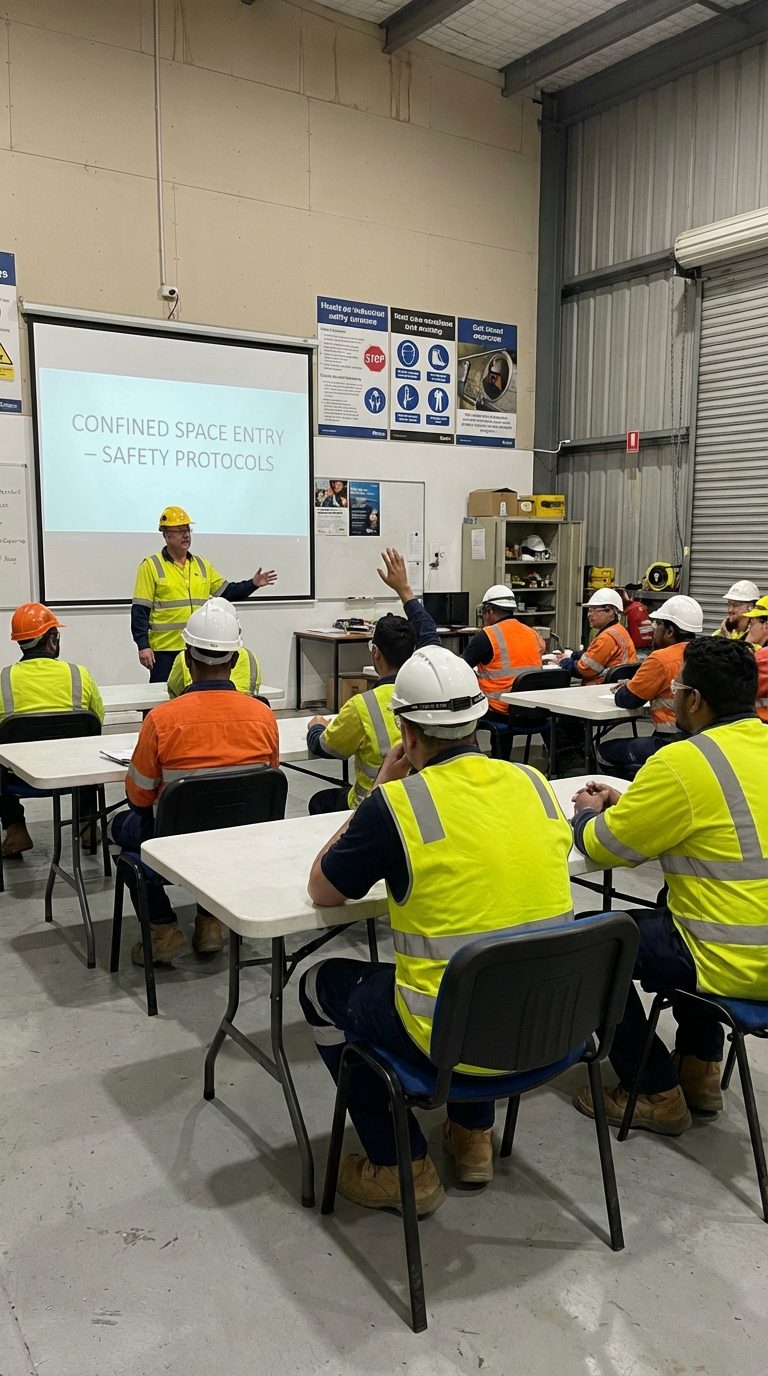
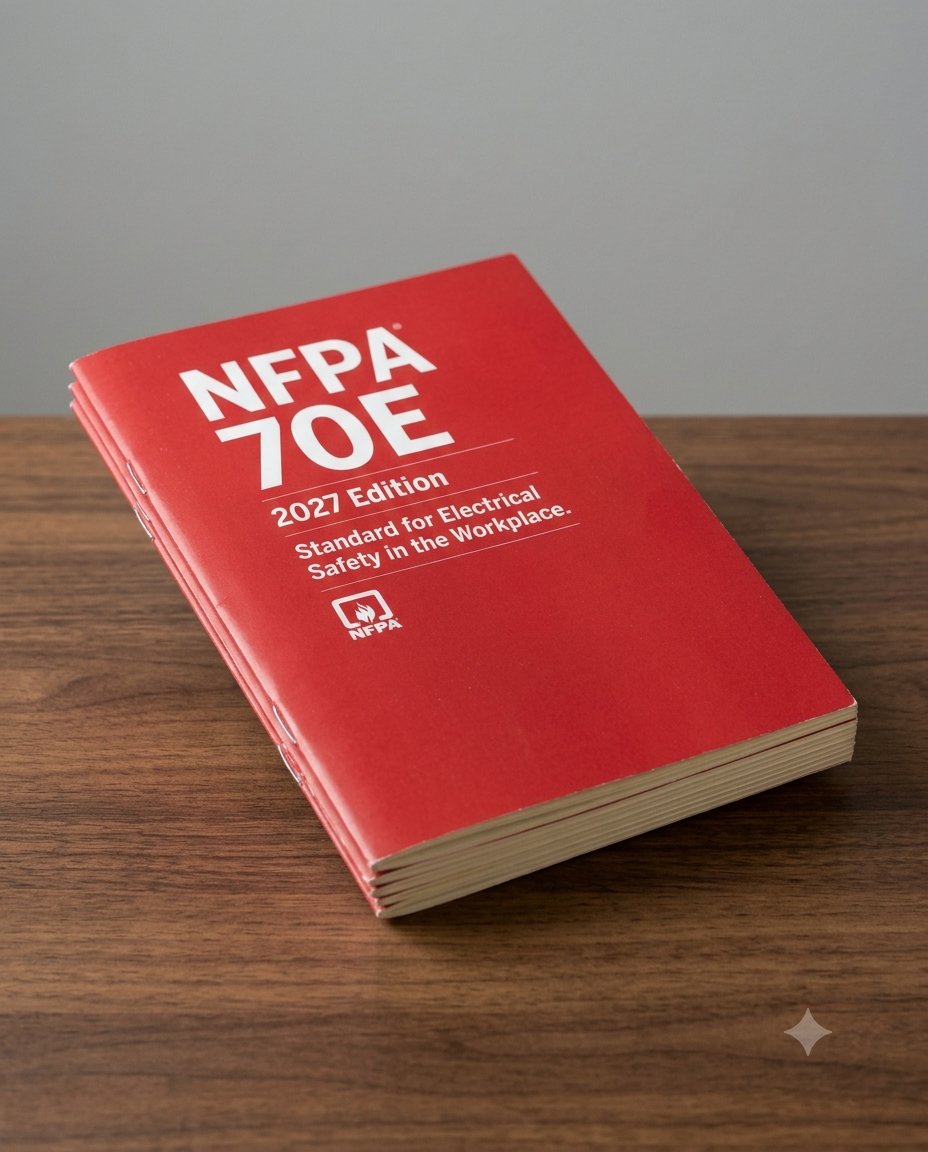
The question comes up in almost every class where somebody in the room has been told they are going to start teaching this internally. They want to know which arc flash instructor certification to go get.
The honest answer is that there is not one. The NFPA publishes NFPA 70E. It does not certify instructors to teach it, and no certificate from any vendor confers authority to teach the standard. Anyone selling you one is selling you their own credential, which may be perfectly good training and is still not a licence.
That is not a dead end. It just means the question is the wrong shape. What matters is not a card in a wallet — it is whether the person at the front of the room can be shown to be qualified, and whether the training they deliver produces what the standard actually asks for.
What establishes an instructor’s standing
NFPA 70E defines a qualified person as someone who has demonstrated skills and knowledge related to the construction and operation of the electrical equipment and installations, and who has received safety training on the hazards involved. Qualification is established by training plus task-specific demonstration — not by attendance.
Two things follow from that definition that people teaching internally should sit with.
First, qualification is task and equipment specific. The 2027 edition restores explicit language on this point. A person can be qualified for some equipment and unqualified for others. Someone who has spent twenty years in 480 V motor control centres is not thereby qualified on 15 kV switchgear, and an instructor teaching a room that works on both needs to be honest about which half they can speak to from experience.
Second, the qualification standard for an instructor is not lower than for the people they are training. It is the same standard, applied to a wider range of equipment, plus the ability to teach. Being the most senior electrician available is a reason to consider someone, not a qualification in itself.
Could you defend this person in a deposition?
If an incident happens and the investigation asks who trained the injured worker and on what basis that person was competent to do it, what do you hand over? If the answer is “he has been here a long time,” that is the gap. The fix is documentation of the instructor’s own qualification, held to the same standard as everyone else’s.
What the standard requires you to document
NFPA 70E 2027 puts the obligation on the employer at 105.3(A)(2): provide and document employee training. Documentation is not a nice-to-have that a well-organised program adds on top. It is the requirement.
In practice that means, for each person trained, a record of what they were trained on, when, by whom, and what demonstration established that they could do it. The demonstration half is the one that gets skipped. A sign-in sheet proves attendance. It does not establish qualification, and a program built on sign-in sheets has documented the wrong thing thoroughly.
Retraining runs at intervals not to exceed three years. It is also triggered sooner by any of the following, and an in-house instructor is usually the first person in a position to notice them:
- Job tasks or equipment change
- Procedures change
- An incident or near-miss occurs
- Observed performance shows a deficiency
That last trigger is the one an internal instructor is uniquely placed to act on, and the one an outside vendor will never see. If you watch someone in your own plant work in a way that shows the training did not land, the clock resets for that person. Being on site is the real advantage of teaching internally — not the cost saving.
What a defensible set of materials contains
Course materials are where in-house programs most often decay, and the decay is invisible until an edition changes underneath them.
The 2027 edition of NFPA 70E has been in effect since May 6, 2026. A deck still teaching the 2024 edition as current is not merely dated — it will teach section numbers that have moved. Article 130 is the clearest example: in 2027, 130.2 is “Work Involving Electrical Hazards” and the energized electrical work permit sits at 130.3, where the 2024 edition had the permit at 130.2. A deck that cites 130.2 for the EEWP is now citing the wrong article, and it will be quoted back at you by the one person in the room who has the current standard open on their laptop.
Materials worth defending have, at minimum:
- A stated edition, on the title slide. Not implied. Stated.
- Section citations that have been checked against the current text — not carried forward from the previous revision on the assumption that numbering is stable. It is not.
- Site-specific content. Your own single-line, your own labels, your own equipment. Generic decks teach the standard; they do not teach the plant, and the plant is what people go back to.
- A demonstration component, because that is what converts attendance into qualification.
- A revision record. When the deck changed, what changed, and who approved it.
The other question that comes with materials is whether you can lawfully reproduce the standard’s text in your own deck. Generally you cannot reproduce substantial portions of a copyrighted standard without permission. Teach from it, cite it, require students to have access to it — but do not build a deck that is effectively a copy of Article 130.
Where train-the-trainer fits
A train-the-trainer course is a reasonable way to develop an internal instructor, and it is worth being clear about what it does. It builds and evidences competence. It does not issue authority to teach, because no such authority exists to issue.
The model works when the person sent already has the electrical background, when they get time to prepare rather than being handed a deck on a Friday, and when someone owns keeping the materials current. It fails predictably when the instructor is chosen for availability, when the materials are never revised, and when the program is measured by how many people were put through it rather than by what they can do afterwards.
We cover that in more depth in our honest guide to NFPA 70E train-the-trainer, including the four ways it usually goes wrong.
The short version
- There is no NFPA arc flash instructor certification. Vendor certificates are evidence of training, not authority.
- What matters is documented qualification — training plus task-specific demonstration — held to the same standard for the instructor as for the students.
- Qualification is equipment-specific. Be honest about the boundaries of what your instructor can teach.
- 105.3(A)(2) requires the employer to provide and document training. Retraining at intervals not exceeding three years, sooner on change, incident, or observed deficiency.
- Materials must state their edition and have their citations checked against it. The 2027 renumbering has already broken decks that were correct in 2024.
If you are standing up an internal program and want a second set of eyes on the materials before they go in front of a room, that is a conversation worth having — get in touch. If you would rather have the class delivered on site, onsite NFPA 70E training is the usual route.