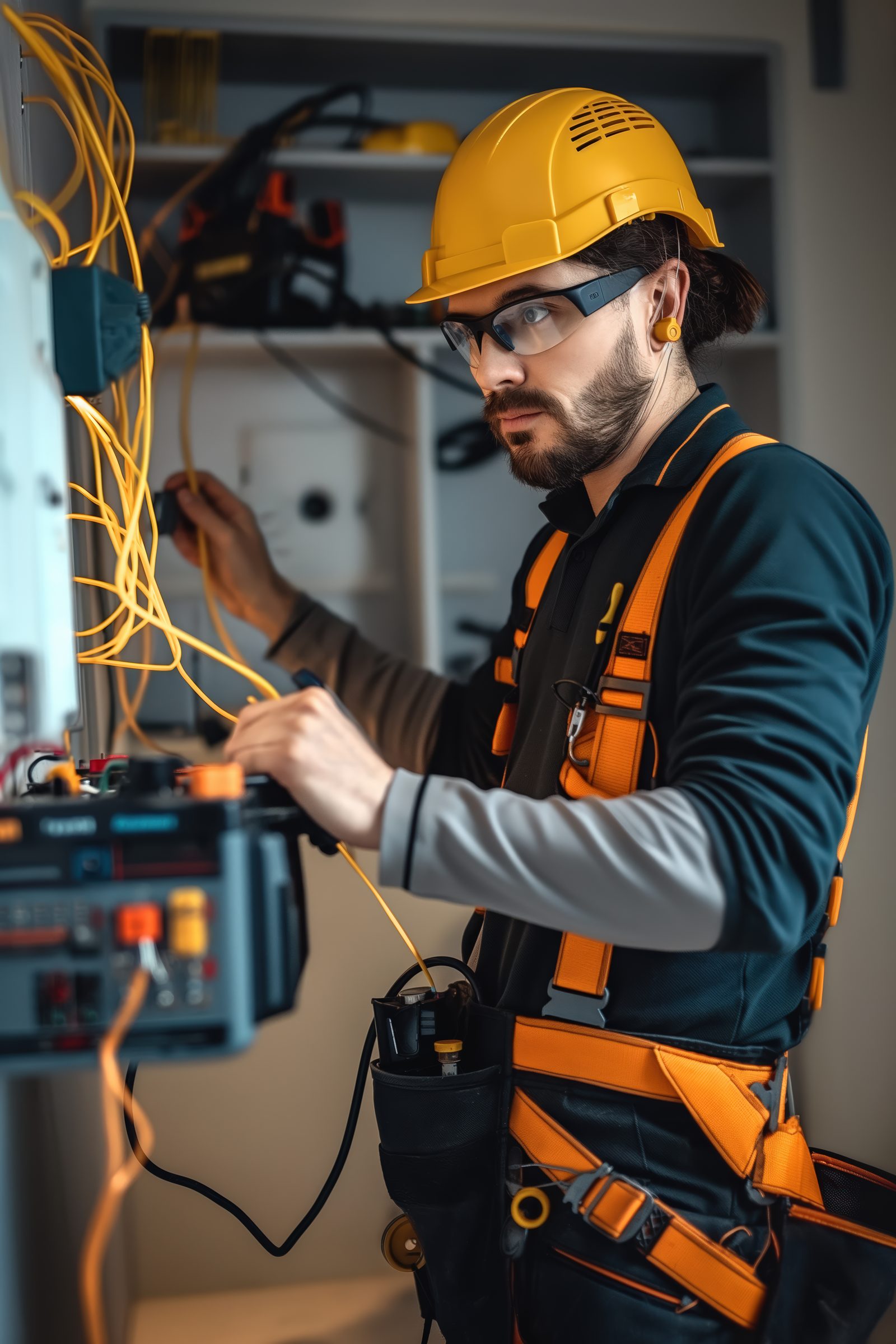
The single most important action you can take right now is to commission or update an arc-flash study, verify your lockout/tagout (LOTO) program covers every energy source in the facility, and get your qualified persons through documented NFPA 70E training. Those three moves address the highest-consequence risks under NFPA 70E, OSHA 29 CFR 1910.147, and 1910.331–335, and they form the foundation of every defensible electrical-safety program in a data center.
Here is where to start, in priority order:
- Commission or update your arc-flash study. If it is more than five years old or the electrical system has changed, it is out of date.
- Audit your LOTO program. Confirm written procedures exist for every piece of multi-energy equipment: UPS systems, automatic transfer switches (ATS), CRAH/CRAC units, and generators.
- Install engineering controls. Closed-panel voltage verification, permanent test points, and remote racking reduce worker exposure before PPE enters the equation.
- Deploy condition-based monitoring. Thermal imaging windows, permanent temperature indicators, and vibration sensors catch faults that scheduled inspections miss.
- Align PPE to incident-energy results. PPE categories must come from the arc-flash study, not from guesswork or generic tables.
- Establish a training cadence. Initial qualification, annual refresher, and task-specific training for every qualified person, with audit-ready records.
- Document everything. Studies, training rosters, LOTO procedures, inspection logs, and energized-work permits must be audit-ready at all times.
Commission the arc-flash study first
Every other decision, from PPE category to energized-work permit thresholds, flows from the incident-energy results it produces.
What engineering controls should you prioritize to reduce worker exposure?
PPE is the last line of defense, not the first. The NFPA 70E hierarchy of risk controls places elimination and engineering controls above PPE, and in a data center, that distinction has real consequences. High-density power infrastructure means fault energy levels that can exceed what any PPE category is rated to handle.
The controls that deliver the most exposure reduction in data center environments:
- Closed-panel voltage verification. Permanently installed voltage indicators let technicians confirm live or dead status without opening a panel. No open panel means no arc-flash boundary exposure.
- Permanent thermal monitoring windows. Infrared-transparent viewports installed on switchgear and PDU enclosures allow thermal scans under load without removing covers.
- Remote racking and switching. Remote racking devices let workers rack breakers in or out from outside the arc-flash boundary. Remote switching removes the human from the fault zone entirely.
- Arc-resistant switchgear. For new builds or major switchgear replacements, arc-resistant equipment redirects fault energy away from the worker.
- Permanent temperature indicators. Provide continuous temperature data without any panel access, supporting condition-based monitoring between formal thermal surveys.
Each of these controls reduces the probability that a worker is present when a fault occurs, or reduces the energy they are exposed to if they are.
What does an arc-flash study cover, and how often should you update it?
An arc-flash study, formally called an incident-energy analysis, is the technical foundation of your entire electrical-safety program. Without current study results, PPE categories are guesses and energized-work permits lack a defensible basis.
For a data center, the study scope must include every point where a worker could be exposed to arc-flash energy: main switchgear, distribution switchgear, busways, molded-case and low-voltage power circuit breakers, UPS systems, power distribution units (PDUs), distribution transformers, automatic transfer switches, and high-density rack PDUs where applicable.
| Update Trigger | Recommended Action | Required Documentation |
|---|---|---|
| Five years since last study | Full incident-energy analysis | Updated one-line diagram, new arc-flash labels |
| New UPS, ATS, or generator added | Partial or full restudy | Revised one-line, updated labels for affected equipment |
| Utility service change | Full restudy | Updated fault-current data, revised labels |
| Breaker or fuse replacement (different rating) | Partial restudy | Updated protection coordination study |
| Significant load increase (AI/HPC expansion) | Full restudy | Revised one-line, new incident-energy calculations |
| Post-incident review | Targeted restudy | Incident report, corrective action documentation |
The five-year review cycle is a maximum interval, not a target. AI and high-performance computing workloads are driving load changes that alter fault energy levels faster than traditional data center expansions. If your facility has added high-density compute in the last two years, treat that as a system change requiring a restudy.
The study must be performed by a qualified electrical engineer, typically a licensed PE with power systems experience, or a qualified third-party firm.
How do you select PPE and avoid overreliance on it?
PPE selection in a data center starts with the incident-energy analysis. The study assigns a calculated incident energy (in cal/cm²) at each work location. That number determines the minimum arc rating of the PPE required, not a generic category table.
A practical PPE selection flow:
- Pull the incident-energy value for the specific equipment from the arc-flash study.
- Select PPE with an arc rating at or above that value (arc rating = ATPV or EBT, measured in cal/cm²).
- Confirm the full PPE ensemble: arc-rated face shield or arc flash suit hood, arc-rated gloves over rubber insulating gloves, arc-rated clothing, leather work boots.
- Inspect PPE before each use. Damaged arc-rated clothing loses its rating. Rubber insulating gloves require periodic electrical testing per ASTM F496.
- Document PPE assignments by task and equipment location.
The limitation that most programs underestimate: PPE works only when worn correctly, every time, by a worker who is not rushing. Engineering controls that reduce exposure time or eliminate panel access are more reliable than assuming flawless PPE donning under time pressure.
Run a pre-job briefing before any energized work
Confirm the PPE category, review the energized-work permit, verify the test instrument is rated for the voltage, and walk through the live-dead-live verification sequence. Five minutes of briefing prevents the most common field errors.
What maintenance and inspection practices prevent electrical failures?
The shift from time-based to condition-based maintenance is the most significant change in data center electrical-safety practice over the last several years. NFPA 70B (2023) was elevated to a mandatory standard and now explicitly supports continuous monitoring and predictive maintenance approaches.
The most common root causes of electrical downtime in data centers are loose connections, overloaded circuits, overheating busbars or cables, UPS battery failure, and breaker or switchgear faults.
| Asset | Monitoring Method | What It Detects | Inspection Cadence |
|---|---|---|---|
| Switchgear and MCCs | Closed-panel IR windows + thermal camera | Hot spots, loose connections, overloaded phases | Quarterly thermal scan |
| Busbars and cable trays | Permanent temperature indicators | Sustained overheating trends | Continuous / monthly review |
| UPS systems | Battery impedance testing + thermal | Cell degradation, connection resistance | Semi-annual |
| Breakers (MCCB/LVPCB) | Infrared + trip-time testing | Contact wear, thermal anomalies | Annual or per manufacturer |
| Transformers | Thermal imaging + oil analysis | Winding hot spots, insulation degradation | Annual |
| Generators | Vibration analysis + load bank testing | Mechanical wear, fuel system issues | Semi-annual |
Documented condition history does two things simultaneously: it supports compliance by demonstrating a structured maintenance program, and it gives you the trend data to predict failures before they cause downtime. An undocumented inspection is, from a compliance standpoint, an inspection that did not happen.
Which U.S. standards and regulations apply to data center electrical safety?
The regulatory framework for electrical safety in data centers layers three primary authorities: NFPA 70E, NFPA 70B, and OSHA's electrical-safety regulations.
NFPA 70E is the primary standard for electrical-safety work practices. It requires a risk assessment before any electrical work, arc-flash labeling on all equipment, a hierarchy of risk controls, and written energized-work permits when live work is justified.
NFPA 70B (2023) governs electrical equipment maintenance. Now a mandatory standard rather than a recommended practice, it requires documented preventive-maintenance programs and supports condition-based monitoring approaches.
OSHA 29 CFR 1910.331–335 sets the federal electrical-safety-related work practices requirements, requiring deenergization as the default. OSHA 29 CFR 1910.147 governs the control of hazardous energy (LOTO) — the highest-impact compliance risk for data centers, given multi-energy equipment like UPS systems, ATS units, and generators.
How do you define 'qualified persons' and build a training program?
Under NFPA 70E and OSHA 1910.331–335, a "qualified person" is someone who has demonstrated skills and knowledge related to the construction and operation of electrical equipment and has received safety training to recognize and avoid the hazards involved. The definition is task-specific: a person may be qualified for one type of work and not another.
| Training Type | Audience | Frequency | Deliverables |
|---|---|---|---|
| Initial NFPA 70E qualification | All electrical workers and supervisors | Before first energized-work task | Certificate, competency record |
| Annual refresher | All qualified persons | Annual | Updated certificate, training roster |
| Task-specific training | Workers assigned new equipment types | Before first task on new equipment | Task-specific competency record |
| Train-the-trainer | Internal safety leads | As needed | Instructor certification, curriculum |
| LOTO-specific training | All workers who perform LOTO | Initial + annual | LOTO competency record |
How do LOTO, energized-work permits, and pre-job planning work in practice?
LOTO in a data center is more complex than in most industrial settings because the equipment has multiple energy sources that must all be isolated. A UPS system, for example, carries AC input, DC bus energy stored in battery strings, and AC output. Isolating only the AC input leaves lethal DC voltage present.
A compliant LOTO procedure for data center equipment must:
- Identify every energy source: AC feeds, DC bus, battery strings, capacitor banks, stored mechanical energy (spring-loaded breakers).
- Notify affected workers and post the equipment as out of service.
- De-energize and isolate each energy source in the correct sequence.
- Apply a personal lock and tag to each isolation point.
- Release or restrain stored energy (discharge capacitors, block spring mechanisms).
- Verify the absence of voltage using a properly rated test instrument: live-dead-live sequence.
- Document the procedure, the workers involved, and the verification result.
LOTO procedures for data centers must explicitly address stored energy in DC bus capacitors and battery strings, and must include group lockout procedures for multi-isolation equipment like generators, which commonly require six to nine isolation points.
Red flags that should trigger elevated controls or third-party support: incident energy above 40 cal/cm² (the upper limit of standard PPE categories); multi-source equipment with no written LOTO procedure; battery string work on large UPS systems; work on equipment with no current arc-flash label; any task where the worker is uncertain about isolation verification.
Why are engineering controls and continuous monitoring now non-negotiable?
AI workloads are changing the risk profile of data center electrical systems faster than most safety programs can track. AI-driven, high-density data centers change load behavior and increase fault energy, making traditional periodic inspections insufficient.
The shift is driven by two factors. First, higher rack power densities create larger and more volatile load swings, which stress connections and increase the probability of thermal faults. Second, the fault energy at distribution equipment rises with load, meaning an arc-flash study conducted before an AI expansion may understate the actual incident energy workers face today.
Technologies to prioritize: closed-panel thermal imaging windows on all critical switchgear; permanent temperature indicators on busbars and high-load connection points; remote switching and racking on critical breakers; and trend analytics that flag a connection point rising 5°C over three months, rather than raw sensor readings alone.
A 90/180/365-day implementation checklist for your electrical-safety program
Days 0–90: Assess and stabilize
- Commission an arc-flash study, or verify the existing one is current (Electrical Manager).
- Audit all LOTO procedures against actual equipment (Safety Manager).
- Identify the five highest incident-energy assets and flag for engineering control upgrades (Electrical Manager).
- Verify all arc-flash labels are present, legible, and consistent with study results (Safety Manager).
- Confirm training records are current for all qualified persons (EHS Manager).
Days 91–180: Implement controls and training
- Install closed-panel IR windows and permanent test points on the five highest-risk assets.
- Deliver NFPA 70E training (initial or refresher) to all qualified persons.
- Update LOTO procedures to address stored energy and group lockout gaps.
- Establish a condition-monitoring schedule: quarterly thermal scans, monthly trend review.
Days 181–365: Sustain and improve
- Conduct the first full thermal survey using newly installed IR windows.
- Review and update the arc-flash study if any system changes occurred during implementation.
- Complete annual refresher training for all qualified persons.
- Conduct an internal compliance audit against NFPA 70E, NFPA 70B, and OSHA 1910.147.
Key Takeaways
| Point | Details |
|---|---|
| Arc-flash study cadence | Review and update at least every five years, or sooner after any significant system change. |
| LOTO complexity | Data center LOTO must address all energy sources, including DC bus, battery strings, and stored energy in capacitors. |
| Engineering controls first | Closed-panel IR windows, permanent test points, and remote racking reduce exposure before PPE is needed. |
| Training documentation | CSP-credentialed instructors and audit-ready records are the standard for demonstrating qualified-person competency. |
Where data center programs actually fail
The gap between a written electrical-safety program and a working one is almost always documentation and LOTO application. Facilities invest in arc-flash studies and PPE, then discover during an audit that the LOTO procedures were written for generic equipment, not the actual UPS model on the floor. Or the training records show a class was held but there is no competency verification, no sign-in sheet, and no certificate. Those gaps are what OSHA citations are built from.
The other pattern worth naming: overreliance on PPE as a substitute for engineering controls. A facility that has invested heavily in arc-rated suits but has not installed a single IR window or permanent test point has the risk hierarchy backwards. PPE fails when a worker is in a hurry, when the suit is damaged, or when the gloves are the wrong voltage rating. Engineering controls do not have bad days.
For contractor buy-in, the most effective approach is to require contractors to produce their own NFPA 70E training certificates and LOTO procedures before they touch any electrical equipment. Make it a condition of the work order, not a request.