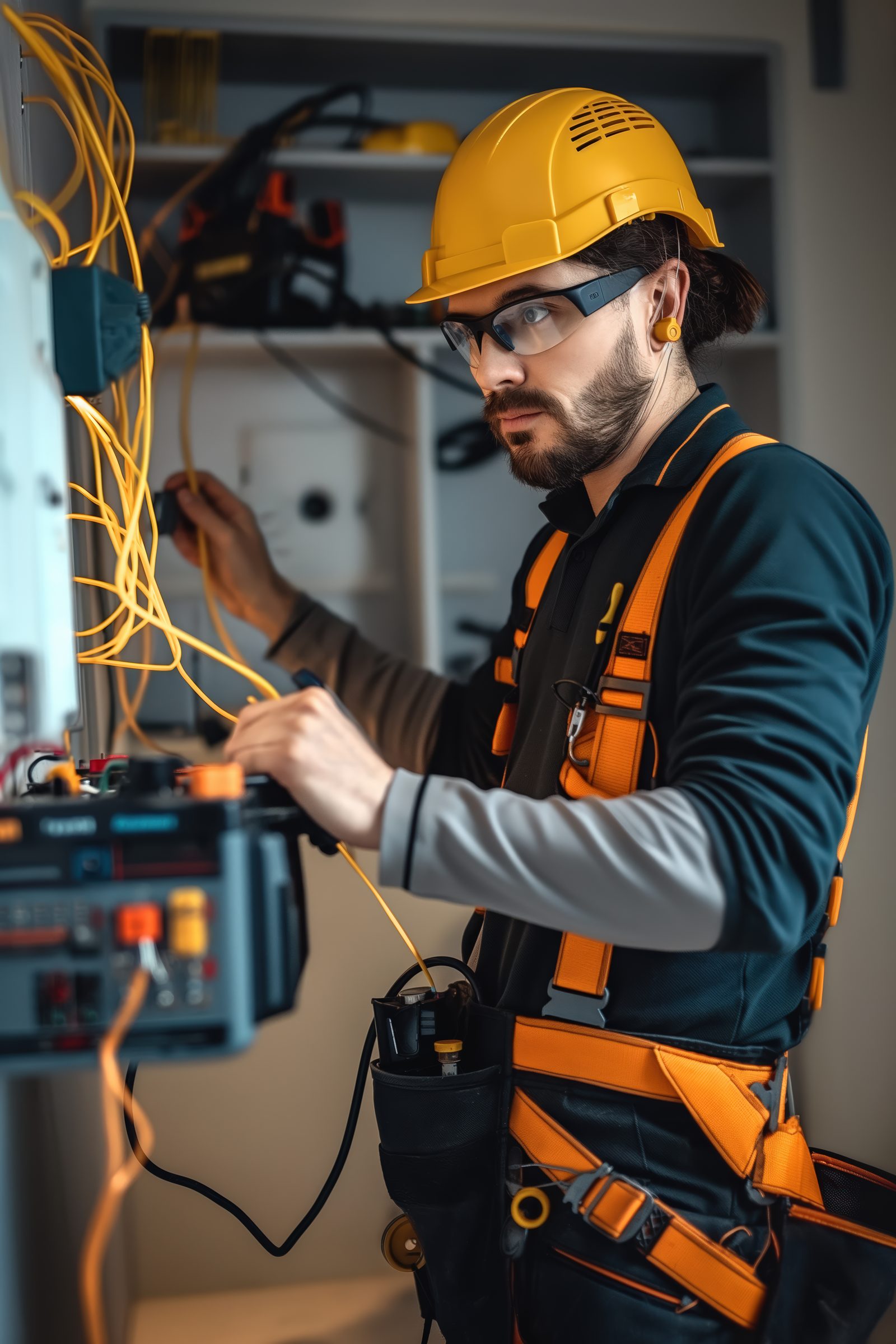
Arc flash training is legally required in the United States for any employee exposed to electrical hazards. Two federal regulations set the floor: 29 CFR 1910.332 covers training for workers who face a risk of electric shock not reduced to a safe level, and 29 CFR 1910.335 addresses PPE obligations for those same hazards. NFPA 70E fills in the technical detail OSHA does not spell out, defining what qualified and unqualified workers must know, how competency gets verified, and how often training must be refreshed.
If you are a safety manager or electrical supervisor reading this, your three immediate actions are:
- Identify every worker group with potential exposure to energized electrical equipment, including non-electrical trades who enter those spaces.
- Pull your training records and check for gaps: missing documentation, expired training, or workers reclassified after a job change.
- Schedule NFPA 70E-aligned training for any group that lacks current, documented competency verification.
Who needs arc flash training at your facility?
The most common compliance gap is not a missing training program. It is a misclassified worker. Safety managers often train their electricians and forget everyone else who routinely enters electrical spaces.
Qualified persons
A "qualified person" under OSHA and NFPA 70E is someone trained and authorized to work on or near exposed energized conductors and circuit parts. Qualified status is not a job title. It is a demonstrated capability, specific to the equipment and voltage levels involved. Qualified status must be demonstrated through on-the-job competence, not just course completion. Training for qualified workers must cover approach boundaries, incident energy, PPE selection, safe work practices, lockout/tagout (LOTO), and the conditions under which energized work is permitted.
Unqualified persons
Unqualified workers need awareness-level training. They must understand that electrical hazards exist, recognize warning signs and labels, know approach boundaries they must not cross, and know when to stop and get a qualified person. This category is broader than most safety managers expect. Per OSHA guidance, it includes:
- Maintenance and janitorial staff who clean near electrical panels
- Machine operators who reset breakers or open enclosures
- Contractors and temporary workers performing non-electrical tasks in electrical spaces
- Supervisors who oversee work near energized equipment but do not perform electrical tasks themselves
Contractors and multi-employer sites
When contractors work at your facility, the host employer carries responsibility for verifying that contractor workers have received appropriate training before they enter electrical hazard areas. NFPA 70E requires the host employer to inform contractors of site-specific hazards and the contractor to confirm their workers are trained to the applicable standard. Document that exchange. An auditor will ask for it.
Quick classification checklist for safety managers:
- List every job title that enters electrical rooms, switchgear areas, or MCC rooms.
- For each title, ask: could this person encounter exposed energized parts above 50 volts?
- If yes, determine whether they perform electrical tasks (qualified) or only work nearby (unqualified/awareness).
- Verify training records match the classification.
- Flag contractors and temps for site-specific orientation before they start.
The US legal and standards framework you need to cite
Understanding how OSHA, NFPA 70E, and IEEE 1584 relate to each other saves you from building a training program on the wrong foundation.
OSHA 29 CFR 1910.332 and 1910.335
29 CFR 1910.332 is the primary federal training requirement. It mandates that training be classroom or on-the-job, and that the degree of training is determined by the risk to the employee. Workers who face electrical hazards that have not been reduced to a safe level must be trained. 29 CFR 1910.335 requires that employees use PPE appropriate to the electrical hazard they face, which ties directly to training on PPE selection and arc ratings.
OSHA does not define "arc flash training" as a standalone term in these regulations. Instead, it sets a performance-based obligation: train workers to the level their hazard exposure demands. That is where NFPA 70E becomes indispensable.
NFPA 70E: the technical benchmark
NFPA 70E is the consensus standard OSHA references when enforcing electrical safety requirements. It defines what qualified and unqualified workers must know, specifies training content for arc flash hazards, and sets the retraining interval. OSHA compliance officers use NFPA 70E as the technical yardstick for what "adequate training" looks like. If your program aligns with NFPA 70E, you are on solid ground in an inspection.
IEEE 1584: where the numbers come from
IEEE 1584 is the industry standard for arc-flash calculations. It provides the methodology for calculating incident energy at specific equipment and determining approach boundaries. Those calculations feed directly into equipment labels and PPE category selection. Training that does not reference the actual incident energy values on your equipment labels is incomplete. Workers need to know how to read a label, what the cal/cm² value means, and which PPE it requires.
Federal vs. state OSHA plans
Twenty-nine states and territories operate their own OSHA-approved state plans. State plans must be at least as effective as federal OSHA, and many adopt NFPA 70E by reference. Some states, including California (Cal/OSHA) and Michigan (MIOSHA), have additional or more specific electrical safety requirements. If your facility operates in a state with its own OSHA plan, verify whether state rules add requirements beyond the federal baseline before finalizing your training program.
What arc flash training must actually cover
OSHA requires training appropriate to the employee's assigned work, but NFPA 70E specifies the content. Here is what a compliant program covers:
1. Hazard recognition
Workers must identify electrical hazards before they approach equipment. Delivery: classroom instruction plus a facility walkthrough.
2. Arc flash and approach boundaries
Qualified workers must understand limited, restricted, and arc flash boundaries and know what PPE and authorization each requires. Delivery: classroom, followed by a written quiz.
3. PPE selection and arc ratings
Selecting the wrong PPE is as dangerous as wearing none. Workers must match PPE to the incident energy or PPE category shown on the equipment label. Delivery: hands-on demonstration and observed selection exercise.
4. Safe work practices and electrically safe work conditions
Workers must know the steps to establish an electrically safe work condition: de-energize, isolate, lock out, test for absence of voltage, and apply grounds where required. Delivery: on-the-job supervised practice.
5. Lockout/tagout (LOTO)
LOTO is both a training topic and a separate OSHA requirement under 29 CFR 1910.147. Training must cover the facility's specific LOTO procedures, not just the general concept.
6. Energized electrical work permits
When energized work is permitted, workers must understand the conditions that justify it, how to complete an energized electrical work permit, and the additional PPE and precautions required.
7. Voltage detector use and testing
Workers must know how to test for the absence of voltage using an appropriate voltage detector, including how to verify the tester is functioning before and after use. Delivery: hands-on demonstration.
8. Emergency response
Training must cover what to do when an arc flash incident occurs: how to respond to an injured worker, how to call for emergency services, and basic first aid for electrical burns. Delivery: classroom plus tabletop scenario.
Awareness-level vs. qualified-person depth: unqualified workers need to recognize hazards, respect boundaries, and know when to stop. Qualified workers need to perform procedures, select PPE, and demonstrate competence on specific equipment. The same topic appears in both curricula, but the depth and the assessment standard differ significantly.
Design assessments that mirror real tasks
A generic multiple-choice quiz tells you whether someone read the slides. A scenario where a worker must walk through the steps to establish an electrically safe work condition on your actual MCC tells you whether they can do the job.
How arc-flash hazard analysis and labeling shape your training
Training content cannot be generic if your equipment labels carry specific incident energy values. The two must align. An arc-flash hazard analysis identifies the energy available at each piece of electrical equipment and calculates the incident energy a worker would be exposed to during an arcing fault. The analysis also establishes the arc flash boundary, the distance at which a worker would receive a curable burn. IEEE 1584 provides the calculation methodology.
Equipment labels must show, at minimum: the incident energy level (in cal/cm²), the arc flash boundary, the required PPE category or specific PPE, and the working distance. Training must teach workers to read those labels and act on them. A worker who sees "8.5 cal/cm²" on a panel needs to know exactly which PPE that requires before they open the door.
When incident energy calculations are not available for a specific piece of equipment, workers must default to safe work practices and higher-PPE defaults. Training should prepare workers for both labeled and unlabeled scenarios, and the rationale for the default PPE selection must be documented.
| Trigger | Required action |
|---|---|
| Initial installation or commissioning | Perform arc-flash hazard analysis before energizing |
| Major electrical system changes | Reassess affected portions of the system |
| Every five years (maximum interval) | Full reassessment per NFPA 70E |
| Changes to utility source or fault current | Reassess immediately |
| Incident or near-miss involving arc flash | Review and reassess affected equipment |
Retraining schedules, triggers, and the records auditors want to see
NFPA 70E sets the maximum retraining interval at three years. That is a ceiling, not a target. Treating three years as a safe default is a compliance risk if any of the following triggers occur before that interval expires:
- Observed failure to follow safe work procedures (procedure violation)
- New equipment or changes to existing equipment that alter hazard levels
- Worker changes job duties or is assigned to different equipment
- Changes to NFPA 70E or applicable OSHA regulations
- Results of an incident investigation or near-miss review
- Worker requests retraining or demonstrates uncertainty about procedures
Any of these events requires retraining before the worker returns to the affected task, regardless of when they last completed a scheduled training cycle.
Competency verification methods
Completion of a training course is not competency verification. Auditors expect evidence that workers can apply what they learned. Acceptable methods include a written quiz with a documented passing score, observed task performance signed off by an instructor or supervisor, and hands-on practicals demonstrating PPE selection, LOTO sequence, or voltage testing.
How to build a training program that holds up in an audit
A compliant training program is not a one-time event. Facilities that treat electrical safety as a document-driven, ongoing program with regular audits and verified training records outperform those that run annual training and file the certificates.
Delivery format selection
- Onsite hands-on: Required for qualified workers who must demonstrate LOTO sequences, PPE selection, and voltage testing on actual facility equipment. No virtual substitute for this component.
- Virtual instructor-led: Effective for awareness-level training, regulatory updates, and theory components. Scales well across multiple sites and shift schedules.
- Train-the-trainer: Best for large multi-site organizations that need to sustain ongoing training internally.
- Contractor orientation: A site-specific module covering your facility's hazards, labels, and emergency procedures, documented separately from their employer's training records.
Build a competency matrix that maps each job title to the tasks they perform, the required training topics, and the demonstration method required for each. The matrix becomes your audit document. Involving workers in developing procedures and hazard analyses also produces better compliance and stronger hazard recognition.
Key Takeaways
| Point | Details |
|---|---|
| Legal baseline | OSHA 29 CFR 1910.332 and 1910.335 require risk-appropriate training and PPE for all exposed workers. |
| Who must be trained | Qualified workers, unqualified workers, supervisors, contractors, and temps who enter electrical hazard areas all require training at the appropriate level. |
| Retraining interval | NFPA 70E sets a maximum of three years; procedure violations, new equipment, or job changes require retraining sooner. |
| Audit-ready records | Each training record must capture course name, date, instructor credential, topics, assessment result, and retrain-by date with signatures. |
Why the "just train the electricians" approach will fail your next audit
The conventional wisdom in many facilities is that arc flash training is an electrician problem. Train the maintenance crew, file the certificates, done. That assumption is wrong, and it is the single most common reason facilities fail electrical safety audits.
The exposure standard under OSHA is not about job title. It is about whether a worker could reasonably encounter exposed energized parts above 50 volts. That threshold catches a much wider population than most safety managers initially map: the operator who resets a breaker, the contractor who works in a room with open panels, the supervisor who stands nearby during energized work. All of them need documented training at the appropriate level.
There is a second gap that is equally common. Facilities that do train broadly often treat the three-year interval as a schedule rather than a maximum. They set a calendar reminder and retrain everyone on the same date, regardless of what happened in between. A procedure violation in month 14, a new switchgear installation in month 22, a worker promoted to a qualified role in month 30 — each of those is a retraining trigger that demands action before the calendar fires.
The shift worth making is from training-as-event to training-as-program: a living competency matrix, a trigger-based retraining workflow, and records that reflect actual demonstrated competence rather than attendance. Facilities that make that shift find that audits become routine rather than stressful.